


Your electric car has at least two connector types built into one port. Most UK drivers never need to think about this because it just works. But if you are buying a cable, choosing a charger, or trying to understand what plugs into what, the differences matter.
This is the full breakdown. If you already know what you need and want to buy a cable, here are the Type 2 charging cables I recommend.
Type 2 (Mennekes)
Type 2 is the standard AC charging connector for every electric car and plug-in hybrid sold in the UK and Europe. It has been the mandated standard since 2013, when the European Commission required all public AC charging points to use the seven-pin Type 2 format.
The connector has seven pins. Three carry AC phase power, one is neutral, one is earth, and the remaining two handle communication between your vehicle and the charger. On a single phase home supply, only five pins are active. On a three phase supply, all seven work together.
On single phase, a Type 2 connection delivers up to 7.4kW. That adds roughly 30 miles of range per hour. On three phase, it delivers up to 22kW, adding around 80 miles per hour. Most UK homes are single phase. Workplaces and some public chargers run three phase:
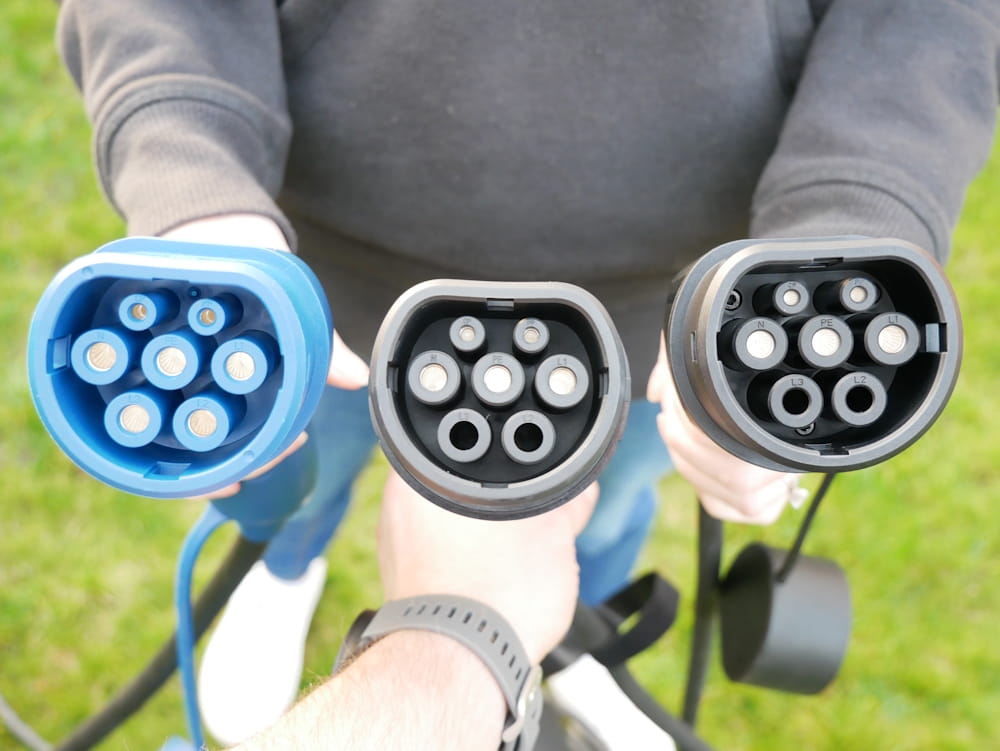
This is the connector you use for everyday charging. At home on your wallbox, at a supermarket car park, at a hotel, at work. If the charger has a socket and no cable attached (untethered), you plug in your own Type 2 to Type 2 cable. One end into the charger, the other into your car.
I have a full guide to what a Type 2 cable is and how it works if you want the detail on pin layouts, Mode 2 vs Mode 3, and cable materials.
CCS (Combined Charging System)
CCS is the rapid charging connector. It takes the Type 2 shape on top and adds two large DC pins below it. This combined design is why it is called the Combined Charging System.
When you pull up to a rapid charger at a motorway services, a forecourt, or a dedicated charging hub, the chunky cable hanging from the unit has a CCS plug on the end. It pushes DC power directly into your battery, bypassing your car’s onboard charger entirely. That is how it delivers 50kW, 100kW, 150kW, or even 350kW depending on the charger and your vehicle.
The important thing to understand is that Type 2 and CCS are not competing standards. They work together. Your car has one charge port. The top half of that port is the Type 2 socket for AC charging. The full port, including the two DC pins at the bottom, is the CCS socket for rapid charging. Two connectors, one port.
You never need to buy a CCS cable. Rapid chargers always have their own cable permanently attached. You grab it, plug in, tap your card or app, and charge. Your Type 2 to Type 2 cable stays in the boot during rapid charging sessions.
CCS has effectively won the rapid charging format war in Europe. Every new EV sold in the UK uses it. The only exception is Tesla, which used a proprietary connector in the US for years, but even Tesla uses CCS on all European models.
I have a complete guide to CCS charging covering speeds, costs, preconditioning, and the 80% rule if you want the full picture on rapid charging.
Type 1 (J1772)
Type 1 is a five-pin AC connector that was common on early electric vehicles, mainly Japanese and American models. If you are buying a new EV in the UK today, you do not need to think about Type 1. It is no longer used on new vehicles sold here.
Where it still matters is the used EV market. The pre-2018 Nissan Leaf, early Mitsubishi Outlander PHEV, and some older Kia and Hyundai plug-in models used Type 1 ports. If you buy one of these secondhand, your charge port is Type 1.
Type 1 is single phase only and handles up to 7.4kW. Functionally, it does the same job as Type 2 for AC charging. The difference is physical. The plug shape is different, so a standard Type 2 to Type 2 cable will not fit a Type 1 vehicle.
If you have a Type 1 car and need to use a public charger with a Type 2 socket, you need a Type 2 to Type 1 cable. One end has a Type 2 plug for the charger, the other has a Type 1 plug for your vehicle. These are widely available and work at any untethered AC charger in the UK.
If you are choosing between a used EV with a Type 1 port and one with a Type 2 port, go Type 2. The charging infrastructure is built around it, cable choice is wider, and you will not need an adapter cable.
CHAdeMO
CHAdeMO is a DC rapid charging connector developed in Japan. It was the original rapid charging standard and appeared on early Nissan Leafs, the Mitsubishi Outlander PHEV, and a handful of other Japanese models.
It uses a completely separate, round connector that looks nothing like Type 2 or CCS. Vehicles with CHAdeMO have it as an additional port alongside their Type 1 or Type 2 AC port.
CHAdeMO is being phased out across Europe. Most new rapid charger installations no longer include a CHAdeMO cable. Some older chargers still have one, but the network is shrinking. Nissan switched to CCS for the Ariya, and no major manufacturer is launching new CHAdeMO vehicles in the UK.
If you own a vehicle with CHAdeMO, you can still find compatible rapid chargers, but availability will continue to decline over the next few years. It is worth factoring this in if you are considering a used EV with CHAdeMO as its only rapid charging option.
Type 3 (Scame)
Type 3 was an early European AC charging connector that competed with Type 2 in the early 2010s. It lost. The European Commission chose Type 2 as the standard in 2013 and Type 3 was effectively retired.
You will not find a Type 3 charger in the UK. A small number of legacy installations may still exist in parts of southern Europe, mainly Italy and France, but they are rare and getting rarer.
If you see Type 3 mentioned online, it is either outdated information or referring to a charger that has almost certainly been replaced by now. I would not give it a second thought when choosing a cable or a vehicle.
Which connector do you need?
If you drive any EV or plug-in hybrid built for the UK market from 2018 onwards, your car uses Type 2 for AC charging and CCS for DC rapid charging. That covers the vast majority of drivers.
You need to buy a Type 2 to Type 2 cable. This is the cable you use at home on an untethered wallbox and at public AC chargers. A 7 metre, 32A cable is the right choice for most people. I have tested three and written up the results in our Type 2 charging cable comparison.
You do not need to buy a CCS cable. Rapid chargers always have their own cable attached.
If you have an older EV with a Type 1 port (pre-2018 Nissan Leaf, early Outlander PHEV, some older Kia and Hyundai models), you need a Type 2 to Type 1 cable instead.
If your vehicle has CHAdeMO, you can still use it at compatible rapid chargers, but the network is shrinking. Your AC charging cable (Type 2 to Type 2 or Type 2 to Type 1 depending on your port) is unaffected by this.
Not sure which cable length to go for? I have a separate guide on that too.
FAQs
Are Type 2 and CCS the same?
No, but they are related. Type 2 is the AC charging connector. CCS uses the Type 2 shape on top and adds two DC pins below for rapid charging. Your car has one port that accepts both. The top half takes a Type 2 plug for AC charging at home or in public. The full port takes a CCS plug for DC rapid charging at motorway services and charging hubs. You need a Type 2 cable. You do not need a CCS cable.
What is the difference between Type 2 and Type 3?
Type 3 was an early European charging connector that lost out to Type 2 when the European Commission standardised on Type 2 in 2013. Type 3 is effectively extinct. You will not find Type 3 chargers in the UK and they are extremely rare across Europe. Every public AC charger and home wallbox in the UK uses Type 2.
Can I use a Type 2 cable on a CCS charger?
No. A CCS charger delivers DC power through a larger plug that includes the two additional DC pins. Your Type 2 to Type 2 cable only has the seven-pin AC connector. It physically will not fit a CCS charger. This is not a problem in practice because CCS chargers always have their own cable attached. You never need to bring one.
Do I need an adapter for my Nissan Leaf?
It depends on the model. The pre-2018 Nissan Leaf has a Type 1 AC port. You need a Type 2 to Type 1 cable to charge at public AC chargers and most home wallboxes. The post-2018 Leaf uses Type 2, so a standard Type 2 to Type 2 cable works. Check your charge port to confirm which version you have.
