


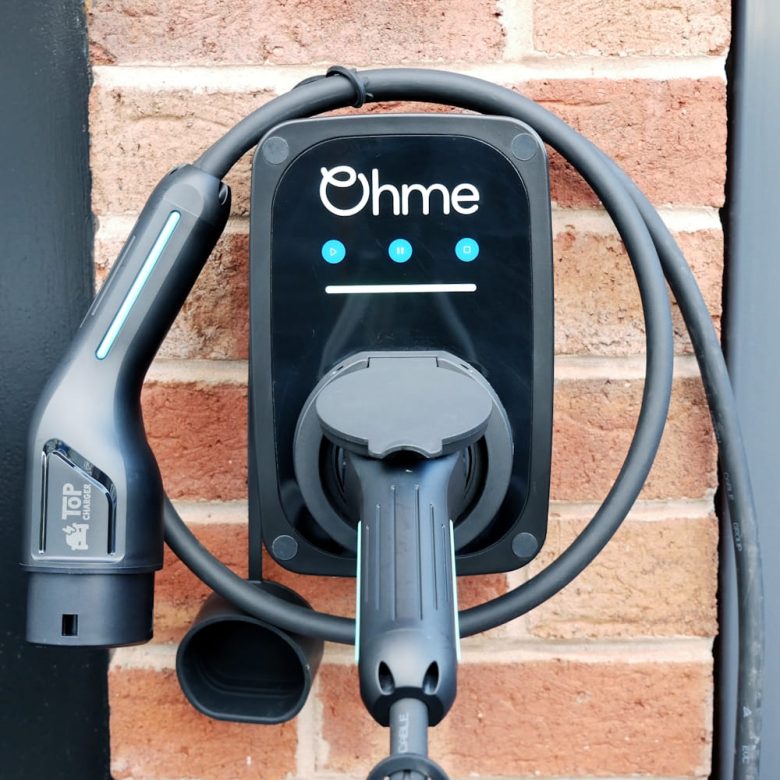


We first published our Ohme ePod review in November 2023 after installing and inspecting the unit with our partners at 247 EV. We’ve since updated the article to correct spec errors in our original version, add the full technical data from Ohme’s latest installation guide (February 2025), and cover new features like Solar Boost that weren’t available at launch.
Your search for the perfect home EV charger could be over with the Ohme ePod if you’re after:
- An untethered charger with a universal Type 2 socket
- Physical controls in addition to an app
- A small and discreet installation (at just 1.5kg and 230mm x 140mm x 100mm, it’s roughly the size of an A4 sheet of paper)
Here it is with the Top Charger cable:
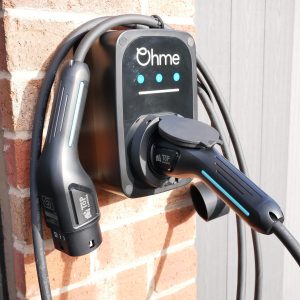
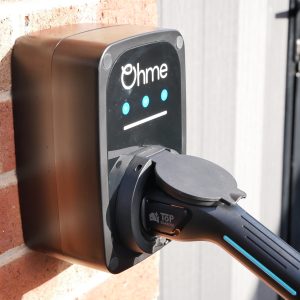
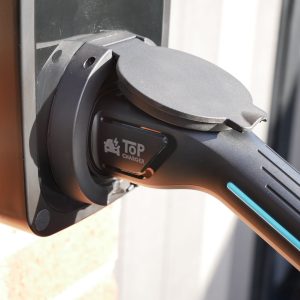
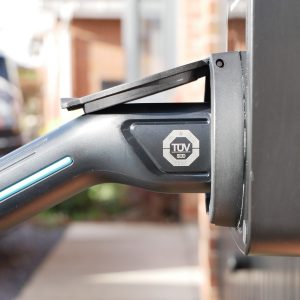
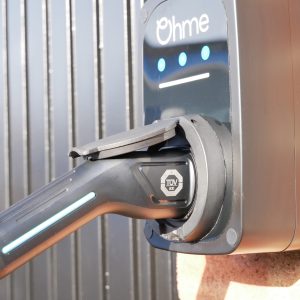
Having installed and inspected the Ohme ePod with 247 EV, our view is that it’s the best smart charger for anyone who wants a small, discreet installation paired with the strongest tariff integration on the market.
It doesn’t have a Type 2 cable built-in, so you’ll need your own. Most EVs come with one in the boot, or you can pick up a 5-metre cable for around £75-£100.
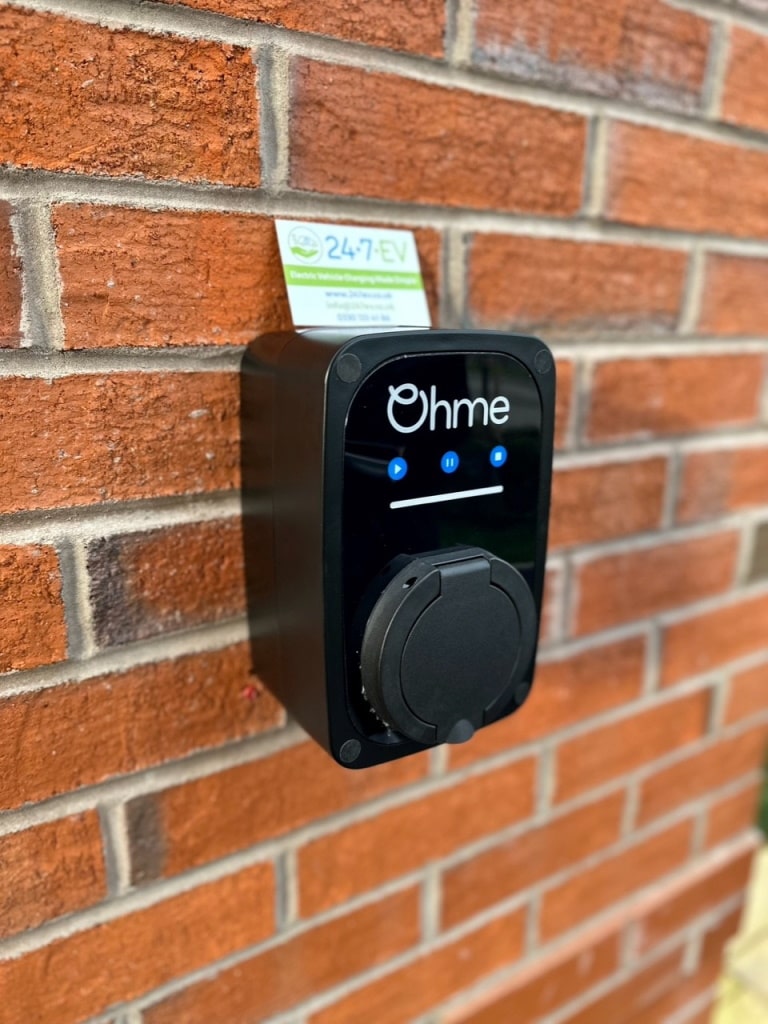
The smart buttons are a nice touch. Play starts a smart charging session (hold for three seconds for Max Charge), pause pauses, stop ends it. Simple enough that you won’t need the app for day-to-day use once everything is set up.
But is the Ohme ePod the right charger for you? Let’s get into it.
Ohme ePod pricing and grants
The Ohme ePod is available from around £409 for the charger unit alone, or from £949 including standard installation (prices as of early 2026, via Ohme directly). Prices vary by installer, and additional costs can creep in for longer cable runs, consumer unit upgrades, or groundwork.
The Ohme ePod is OZEV-approved and eligible for the following grants:
- EV chargepoint grant (UK): Up to £350 off for renters and flat owners (the homeowner grant ended in April 2022, but the renter/flat owner grant remains available).
- SEAI grant (Ireland): Up to €300 off installation costs.
Remember to factor in a Type 2 charging cable if you don’t already have one. A decent 5-metre cable costs around £75-£100, and a 10-metre option runs closer to £150-£200.
Ohme ePod review
Summary
The Ohme ePod is a strong choice for EV drivers who want the smartest tariff integration in the smallest package. It comes with a 3G/4G multinet SIM card, free software updates, built-in PEN fault protection, Solar Boost compatibility, and the ability to set price caps. The 36-month warranty covers parts, labour and on-site assistance. The main downsides are the lack of a cable lock for security and the OVO Charge Anytime integration being dropped in 2025.
Why we scored it that way
Design: 5/5. Nothing else on the market comes close in terms of size and weight. At 1.5kg and 230mm x 140mm, it practically disappears on the wall. During our install, the 247 EV team commented that it’s one of the most discreet units they’ve fitted.
Build quality: 4.5/5. The fire-rated PC945(GG) polycarbonate enclosure feels solid in the hand and the internals are well laid out. The half-point deduction is for the IP54 rating, which is a step below the Home Pro’s IP55 and well below the Hypervolt’s IP65. For a sheltered spot it’s fine, but for a fully exposed wall you might want a canopy. We’d also like to see a cable lock for the untethered socket, which competitors like the Easee One already offer.
App/software: 4.5/5. We’ve spent time with the Ohme app across both the ePod and Home Pro reviews, and it’s comfortably the best charger app on the market. Fast, clear, and regularly updated. The half-point deduction is because non-API compatible vehicles miss out on the best features like target battery percentage, and there’s no simple start/stop schedule as a fallback for those cars.
Ease of installation: 5/5. Our 247 EV installer had it on the wall and commissioned in under two hours. The built-in PEN fault protection means no earth rod, the terminal block is easily accessible, and the two cable entry points give flexibility. One of the quickest smart charger installs we’ve seen.
Charging experience: 4.5/5. Based on what we’ve seen during testing and what owners consistently report, the ePod delivers reliable overnight charging with genuine tariff savings. Users on Intelligent Octopus Go typically report monthly charging costs of £18-30 depending on mileage. The half-point deduction is for the 4G dependency, which won’t suit everyone. If you’re in a mobile blackspot, the smart features won’t work (though the WiFi variant exists as an alternative).
This review was produced in collaboration with 247 EV, OZEV Approved Installers of home chargers in Warrington and the surrounding area. We invite you to check out their work on Facebook and visit their web page for a quote.
What owners are saying
We review chargers from the installation and hardware side. But the real test is how they perform over months of daily use. Here’s what we’re consistently hearing from ePod owners and seeing across verified review platforms:
The tariff savings are real. Owners on Intelligent Octopus Go report the ePod reliably finds the cheapest overnight slots, with monthly charging bills typically sitting between £18 and £30 depending on mileage and vehicle. On Octopus Agile, the charger automatically picks the cheapest 30-minute windows.
The 4G connection works for most people. The built-in SIM avoids the WiFi headaches that plague some competitors. Owners generally report solid connectivity, though a handful have experienced issues in areas with weak mobile signal. One owner on the Speak EV forum reported a month-long outage caused by a faulty local mast, during which the charger defaulted to basic charging mode. Worth checking your mobile signal before committing.
The app is well-liked. Across the App Store, Google Play, and owner forums, the Ohme app consistently gets praised for speed, clarity, and reliability. It shows real-time charging data, session history, and cost breakdowns. The main complaint is that non-API compatible vehicles miss out on features like target battery percentage.
One gripe keeps coming up: there’s no cable lock. Because the ePod is untethered, anyone could walk up and unplug your cable. The app has a button lock feature to prevent tampering with the charger itself, and you can require approval for each session. But there’s no physical lock securing the cable to the socket. If your charger faces a public pavement, that’s worth thinking about.
The OVO situation frustrated people. As of July 2025, OVO Charge Anytime no longer integrates with Ohme chargers. Owners who bought the ePod on OVO’s recommendation were left without smart tariff integration. If you’re considering OVO, check the current compatibility before purchasing.
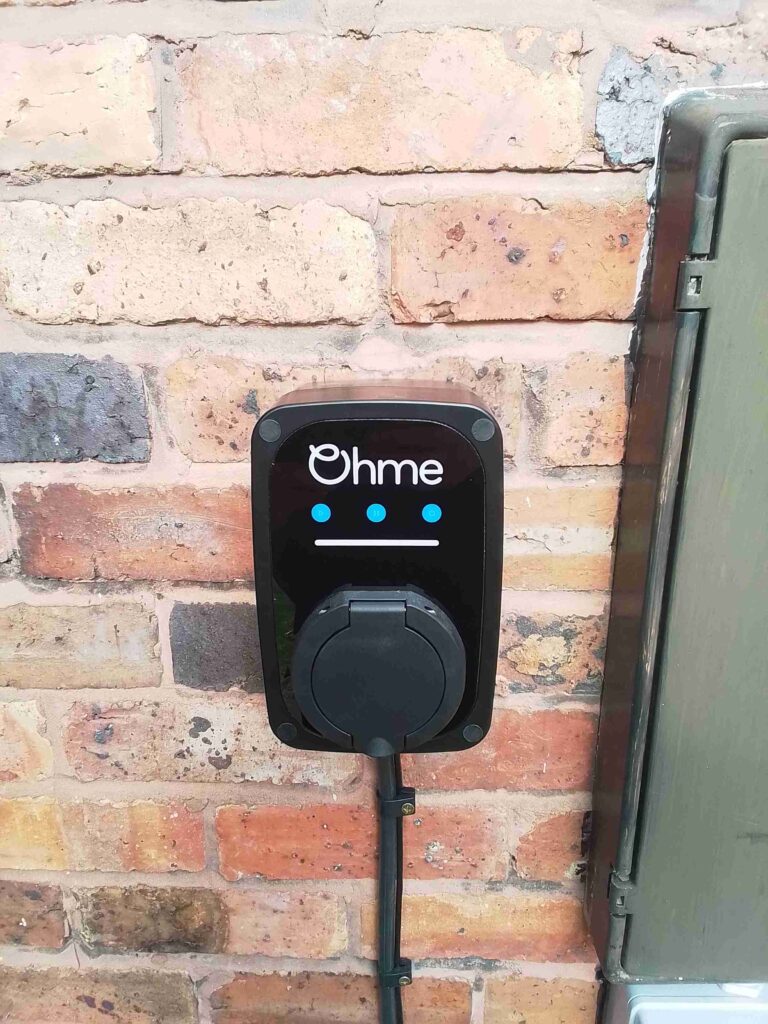
Ohme ePod specifications
We’ve pulled the full specs below from the official Ohme data sheet (November 2023) and the installation guide (February 2025). Our original review had a couple of errors that we’ve corrected, notably the terminal block capacity and the charging speed.
| Specification | Detail |
|---|---|
| Power rating | 7.4kW |
| Rated current | 32A max |
| Nominal supply | 230V AC, 50/60 Hz, single-phase |
| Supply connections | L+N+E 6mm² |
| Terminal block capacity | Up to 10mm² conductor |
| Charging mode | Mode 3 |
| Socket | Type 2 to IEC62196 |
| Dimensions (H x W x D) | 230mm x 140mm x 100mm |
| Unit weight | 1.5kg (shipping: 1.9kg) |
| Enclosure | PC945(GG), Fire Rated (V-0 UL94) |
| IP rating | IP54 |
| Impact rating | IK08 |
| Operating temperature | -25°C to 50°C |
| Storage temperature | -40°C to 85°C |
| Operating humidity | 5-95% RH |
| Connectivity | 3G/4G multinet SIM (cost covered by Ohme for first 3 years) |
| Earth leakage protection | RCD Type A 30mA with integral 6mA DC (IEC62955), built-in PEN fault detector |
| Overcurrent protection | Not fitted; requires separate 40A Type B MCB |
| Load balancing | Dynamic, via included CT clamp (0-50A range) |
| Upgrades | Over-the-air firmware and software |
| Colour | Black |
| Warranty | 36 months (parts, labour and on-site assistance) |
| Mounting | Wall or post mounted, indoor or outdoor |
How easy is the Ohme ePod to install?
Our 247 EV installer had the ePod up and running in under two hours. The compact size made positioning easy, and the two cable entry points (rear or underside) gave flexibility for routing the supply cable. The built-in PEN fault protection meant no earth rod was needed, which saved time and avoided the risk of hitting buried services in the driveway.
For the electricians reading, here are the technical details from the installation guide:
The terminal block accepts up to a 10mm² conductor, with L+N+E supply connections at 6mm². Cable entry points are supplied with M25 glands and blanking grommets that can be swapped between the rear and underside positions. Make sure you seal the unused entry point to maintain the IP54 rating.

The ePod comes with an RCD-DD conforming to IEC62955, featuring a Type A 30mA characteristic with 6mA DC protection. Any upstream RCD should be at least Type A. If the RCD trips, you can reset by power cycling (switch off, wait 5 seconds, switch on) or by unplugging and re-plugging the vehicle.
The charger also contains a built-in PEN fault detection system, conforming to 722.411.4.1 (iv) of BS7671 18th Edition, which disconnects the vehicle wires if voltage drifts above 253V or below 207V. No separate earth rod required.
Important notes for installers
- Overcurrent protection isn’t included and must be fitted separately. Ohme recommends a 40A Type B MCB.
- Dynamic load balancing comes via a CT clamp in the box. It measures household demand (0-50A range) and adjusts charger output to keep you below your fuse rating.
- If load balancing is enabled but the CT clamp fails or gets removed, the charger drops to 16A as a safety fallback. Make sure your spare capacity is at least 16A after accounting for other loads.
- When available capacity drops below 6A, the ePod pauses charging for at least five minutes to prevent rapid switching.
- The CT clamp and wiring are not polarity sensitive, so it can be installed in either direction.
- The WAGO lever connectors supplied are for the load balancing clamp only. Do not use them for main supply connections.

Overall, our installer commented that the ePod is one of the quickest smart chargers to fit because of its size and the straightforward terminal block layout. The commissioning process uses either Ohme’s Installer Web App or the three buttons on the charger itself, and the unit was online and connected to Ohme’s servers within minutes of powering on.
Ohme ePod design
The Ohme ePod is the smallest smart charger we’ve handled. At 140mm wide, it’s noticeably narrower than the Home Pro (200mm), though taller at 230mm versus 170mm. Both share the same 100mm depth. In person, it looks less like an EV charger and more like a small intercom unit.
The enclosure is built from fire-rated PC945(GG) polycarbonate (rated V-0 under UL94), which gives it a solid feel despite the featherweight 1.5kg. The IP54 rating makes it suitable for most outdoor positions, though it’s a step below the Home Pro’s IP55 and well below the Hypervolt’s IP65. For a fully exposed wall with no shelter, a small canopy wouldn’t hurt.

Because it’s untethered, you’ll need to supply your own cable or use the one that came with your vehicle. If you’d rather have a cable permanently attached, the Ohme Home Pro is the tethered option. The untethered setup does mean a cleaner wall when the cable is put away, and if you need a longer cable in the future, you just buy one rather than replacing the entire charger.
The three buttons on the front are responsive and well-spaced. Play starts a smart charging session (hold for three seconds for Max Charge), pause pauses the session, and stop ends it. They can be locked via the app to prevent tampering.

Both Type 1 and Type 2 cables fit the universal socket, though every modern EV uses Type 2. The flexibility of choosing your own cable length is a genuine advantage for buyers with longer driveways or awkward parking setups.
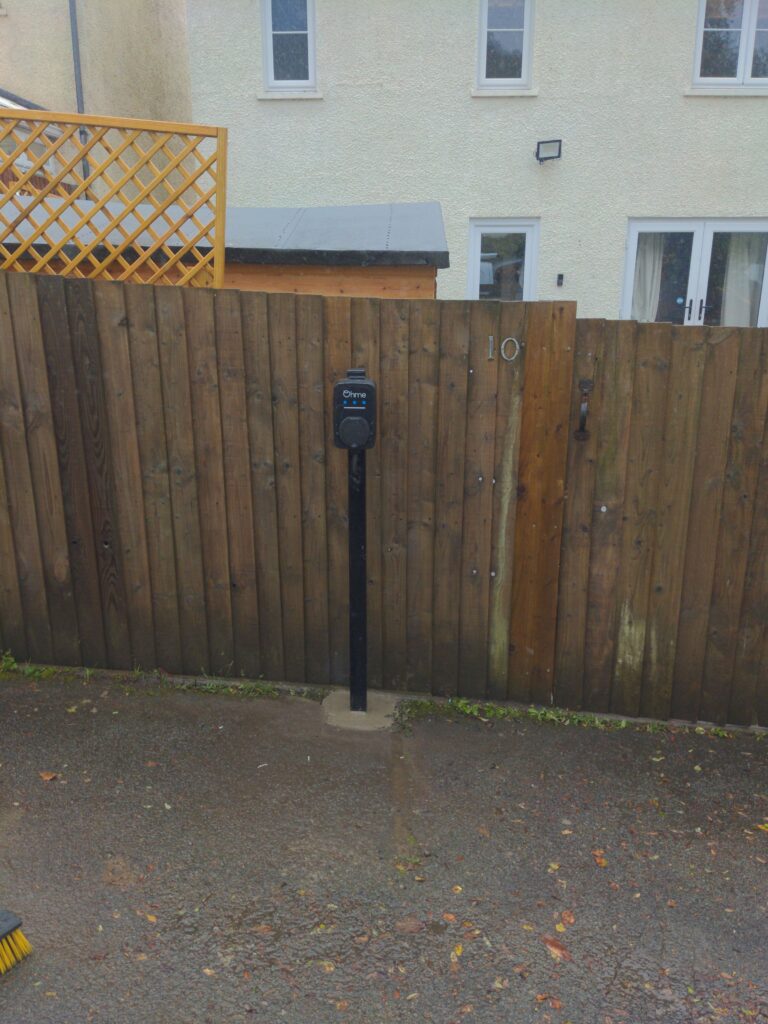
You can also install the Ohme ePod on a post:
Ohme ePod and energy tariffs
The energy tariff integration is, hands down, the best reason to buy an Ohme charger. No other manufacturer offers the same depth of direct API integration with UK energy suppliers.
The ePod integrates directly with:
- Octopus Intelligent Go – the ePod communicates directly with Octopus via API. It doesn’t just charge during the standard six-hour off-peak window. It actively requests additional off-peak slots, which means owners can get extended cheap-rate charging at around 7p/kWh.
- Octopus Agile – prices change every 30 minutes based on wholesale cost. The ePod automatically picks the cheapest windows.
- Octopus Go – fixed off-peak rate during set hours.
- British Gas Electric Drivers / EV Power+
A word on OVO: As of July 2025, OVO Charge Anytime no longer integrates with Ohme chargers. OVO updated their backend technology and Ohme didn’t integrate with the new system. If you’re currently on OVO or considering it, check the latest compatibility before purchasing. A number of ePod owners were caught out by this change.
You don’t need to be on one of those specific tariffs to benefit. You can enter any tariff’s rates into the Ohme app manually, set a maximum price cap per kWh, and the charger will only operate when electricity is below that threshold. It’s not as seamless as the direct API integrations, but it still works.
Ohme app and software
We’ve spent time with the Ohme app across both our ePod and Home Pro reviews, and it’s comfortably the best charger app on the market. It loads quickly, the interface is clean, and it gets regular updates.
Setting up a tariff takes a couple of minutes. Select your provider from the list and the app pulls your rates automatically. From that point, every time a car is plugged in, the ePod creates a charging plan targeting the cheapest slots. The app shows exactly when it plans to charge and how much each session will cost.
The target battery percentage feature works with API-compatible vehicles, meaning the Ohme reads your car’s current battery level and calculates exactly how much charge is needed. If your vehicle isn’t on the API list, you can still set up charging plans manually, though you lose that automatic target feature. Check Ohme’s compatibility list for your specific model.
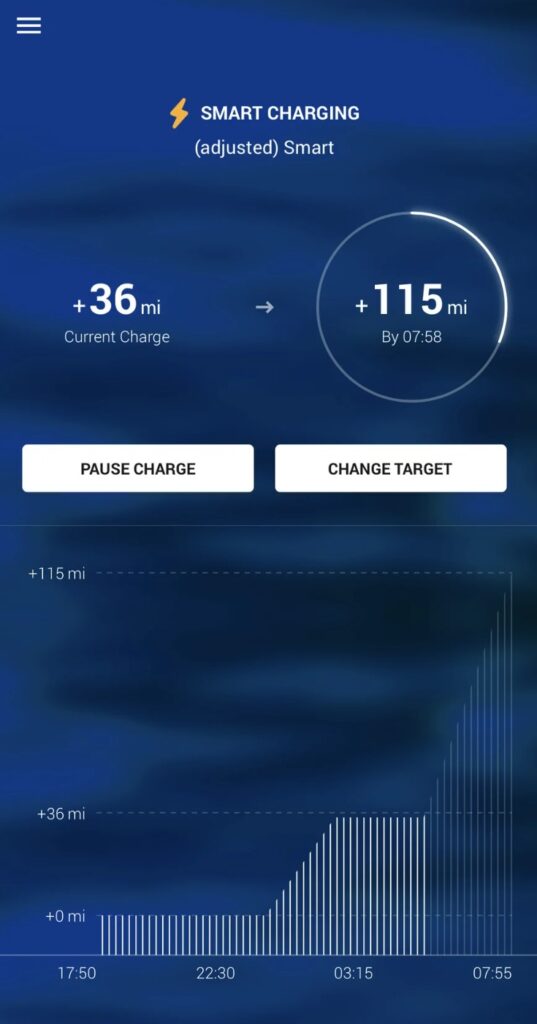
The app (also on Google Play) shows real-time charging data, session history, cost breakdowns, and how green your charge was based on grid carbon intensity.
Key app features
- Tariff integration – connects to your tariff and fetches rates automatically.
- Charge scheduling – set departure times so your car is ready when you are.
- Green charging – prioritises charging when grid carbon intensity is lowest.
- Price caps – set a maximum price per kWh you’re willing to pay.
- Max charging – quick boost when you need it now.
- EV integration – links to your car’s data for battery-aware scheduling (API-compatible vehicles).
- Solar Boost – diverts surplus solar energy to your EV (see below).
- Home Assistant integration – available since Home Assistant 2025.1, if you’re into home automation.
Ohme ePod connectivity
The ePod uses a built-in 3G/4G multinet SIM card rather than your home WiFi. From an installer’s perspective, that’s a big plus. No messing with WiFi passwords during commissioning, no signal issues in detached garages, and no customer callbacks because their router can’t reach the charger.
Ohme covers the SIM cost for the first three years from installation. After that, it’s worth checking Ohme’s current terms. Nobody seems to have hit the three-year mark yet on the newer ePod units, so we’ll update when there’s clarity on post-warranty SIM costs.
If the ePod can’t reach a data connection when a car is plugged in, it falls back to basic “dumb charger” mode. The car still charges at the set amperage, but it won’t schedule sessions or optimise for tariff rates.
A WiFi/Bluetooth variant of the ePod also exists, connecting via your home’s 2.4GHz network instead. Worth considering if you’re in a mobile blackspot, though only around 9% of the UK has that problem.
Ohme ePod solar integration
Update: Solar integration is now live for the Ohme ePod via the “Solar Boost” feature. It’s available for units installed from January 2023 onwards with a CT clamp fitted.
Solar Boost uses the CT clamp to detect surplus energy from your solar PV system and diverts it to charge your EV. It maintains a minimum 5A charge rate, supplementing with grid power when needed, and adjusts dynamically as solar output changes with cloud cover. You can combine Solar Boost with tariff-based scheduling to top up cheaply from the grid overnight and use free solar during the day.
The LED bar shows solid yellow when solar charging is scheduled and moving yellow when it’s actively charging from solar.
In our original review, we flagged the lack of solar integration as the ePod’s biggest weakness. That gap has now been closed. We haven’t tested Solar Boost ourselves, but the feature is confirmed live and working based on reports from owners on forums like Speak EV. If you have panels or plan to install them, the ePod is now a viable option. For dedicated solar diversion, the Myenergi Zappi still has a more mature system with a longer track record.
Ohme ePod charging speeds
The ePod is rated at 7.4kW (32A) on a single-phase supply, the maximum available on a standard UK domestic connection. In real-world conditions, owners typically report seeing around 7.0-7.2kW on the app’s live readout, which is normal given UK voltage variation. That translates to roughly 25-30 miles of range added per hour.
For context, 7.4kW is about twice as fast as a standard 3-pin plug and more than adequate for overnight charging. Most EV drivers will go from 20% to 80% in around 4-5 hours, depending on battery size.
LED status indicators
The ePod has a five-colour LED status strip instead of the Home Pro’s LCD screen. Here’s the full reference from the installation manual:
| LED colour/pattern | Meaning |
|---|---|
| Solid green | Idle, ready to be plugged in |
| Solid green (rightmost LED) | Car connected |
| Moving green (left to right) | Scheduling smart charge |
| Blinking green | Charging complete |
| Solid blue | Smart charging scheduled |
| Moving blue (left to right) | Smart charging in progress |
| Blinking blue | Max charging in progress |
| Solid yellow | Smart charging scheduled with solar enabled |
| Moving yellow | Solar charging in progress |
| Solid white | Max charging delayed (number of LEDs shows hours of delay) |
| Blinking white | Charging session paused |
| Moving purple | Approval pending, respond via Ohme app |
| Blinking purple | Buttons are locked |
| Solid orange | Error communicating with vehicle |
| Blinking orange (rightmost LED) | Connecting to internet |
| Blinking red (rightmost LED) | Error, reboot required (hold STOP for 10 seconds) |
| Solid red (rightmost LED) | Fault, contact Ohme support |
Security, updates and support
The ePod meets security requirements consistent with the ETSI EN 303 645 cyber security standard. Security features are factory-set and can’t be altered by the user. Ohme keeps a security log for each device, with no personal data stored on the charger itself.
The charger is compliant with the UK’s Electric Vehicles (Smart Charge Points) Regulations 2021.
Firmware and software updates arrive over the air automatically. You can also force an update check by power cycling the charger.
Ohme’s help centre is well-stocked and they respond to queries within 48 hours on weekdays. Contact details:
- UK: +44 (0) 20 3375 1586 / ohme-ev.com/support
- Ireland: +353 21 601 0311 / ohme-ev.com/ie/help
Ohme ePod warranty
The ePod comes with a 36-month manufacturer’s warranty from the date of installation. It covers parts, labour, and on-site assistance at no cost. If Ohme can’t repair it, they’ll replace it.
A replacement unit carries the remaining warranty of the original or 180 days from the replacement date, whichever is longer.
The warranty doesn’t cover damage from misuse, negligence, environmental events (fire, flood), cosmetic wear, or unauthorised modifications. Standard stuff for this category.
Ohme ePod verdict
The Ohme ePod earns its place as one of the top-rated chargers on our rankings table. The hardware is compact, well-built, and easy to install. The software is the best in the business. And the energy tariff integration can save hundreds of pounds a year for drivers on the right tariff.

The addition of Solar Boost has closed what used to be the charger’s biggest gap, and the three-year warranty including on-site labour is reassuring.
Where it falls short: There’s no physical cable lock on the untethered socket, which is a security concern for front-of-house installations. The OVO Charge Anytime integration was dropped in July 2025, which left some owners stranded. The IP54 rating is adequate but a step below the Home Pro’s IP55 and well below the Hypervolt’s IP65. And the 4G SIM is great until you’re in a blackspot or Ohme’s three-year coverage period ends with no clarity on what comes next.
Who should buy the Ohme ePod? Anyone who wants the smartest tariff integration in the smallest package, is happy to supply their own cable, and values a clean, unobtrusive installation. If you’re on Octopus Intelligent Go or Agile, the ePod can pay for itself through cheaper charging alone.
Ohme ePod alternatives
A strong alternative is the Hypervolt Home 3 Pro, which offers 7.4kW charging, a capable app, built-in solar integration, and a higher IP65 weatherproof rating.
If solar diversion is your top priority, the Myenergi Zappi remains the benchmark. Its Eco+ mode is more mature than Ohme’s Solar Boost and has been through years of real-world refinement.
The Easee One is worth a look if you want the option of both tethered and untethered in a single unit, something the ePod can’t do.
| Feature | Ohme ePod | Ohme Home Pro | Hypervolt Home 3 Pro | Easee One |
|---|---|---|---|---|
| Power | 7.4kW | 7.4kW | 7.4kW | 7.4kW |
| Type | Untethered | Tethered (5m or 8m) | Tethered | Tethered + untethered |
| Dimensions | 230x140x100mm | 170x200x100mm | 183x283x112mm | 256x219x107mm |
| Weight | 1.5kg | ~5kg (with cable) | 5.2kg | 1.5kg (unit only) |
| IP rating | IP54 | IP55 | IP65 | IP54 |
| Solar | Yes (Solar Boost) | Yes (Solar Boost) | Yes | No (Equalizer add-on) |
| Display | LED strip | LCD screen | LED ring | LED strip |
| Octopus integration | Direct API | Direct API | Yes | Yes |
| Warranty | 3 years | 3 years | 3 years | 3 years |
Ohme ePod vs Ohme Home Pro
The biggest difference is form factor and interface. The Home Pro has an LCD display that shows live charging data, battery percentage (on API-compatible cars), and lets you adjust settings without the app. The ePod replaces all of that with a three-button layout and LED strip.
Having reviewed both, the trade-off is straightforward. If you like seeing numbers on the unit itself rather than reaching for your phone, the Home Pro is the better pick. If you’d rather have a cleaner wall and don’t mind using the app for detail, the ePod delivers the exact same charging intelligence in a smaller, cheaper package.
Dimensionally, the Home Pro is wider (200mm vs 140mm) but shorter (170mm vs 230mm). Once you add the permanently attached 5m or 8m cable and the cable holster, the Home Pro’s total footprint on the wall is significantly larger.
Both chargers deliver identical 7.4kW (32A) speeds, use the same app, the same tariff integration, and the same Solar Boost feature. The ePod is typically £50-£100 cheaper with installation.
Ohme ePod documentation
A special thanks to 247 EV for collaborating with us on this review.
Originally published November 2023. Updated April 2026 with corrected specifications, current pricing, Solar Boost coverage, and owner feedback. Specs verified against Ohme ePod data sheet (November 2023) and Installation Guide V1.0 (February 2025).
