

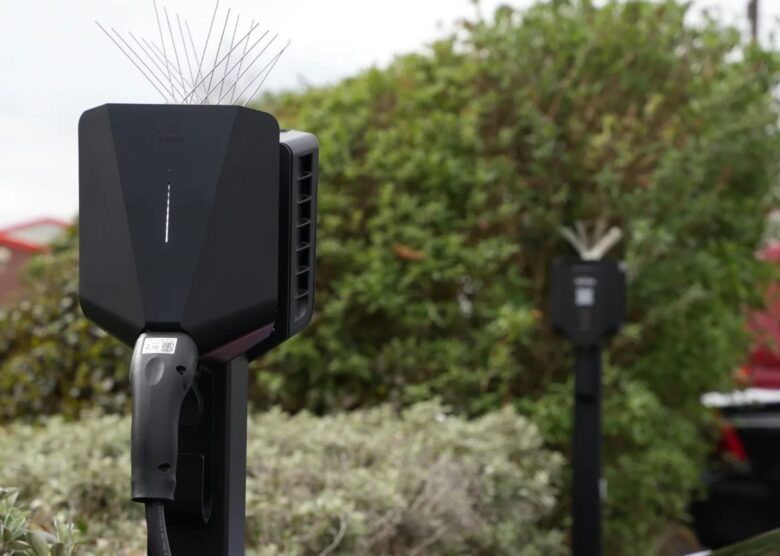
The Easee One charger is a 7.4kW smart home charger priced from £999 with installation. This review covers installation, features, app performance, and charging experience.
The Easee One can run up to three charging units from one 32A electrical supply, making it suited to households with multiple electric vehicles. The charger includes a lockable Type 2 port, letting you use it tethered or untethered. It has integrated eSIM with lifetime 4G connectivity, RFID access control, and over-the-air firmware updates.
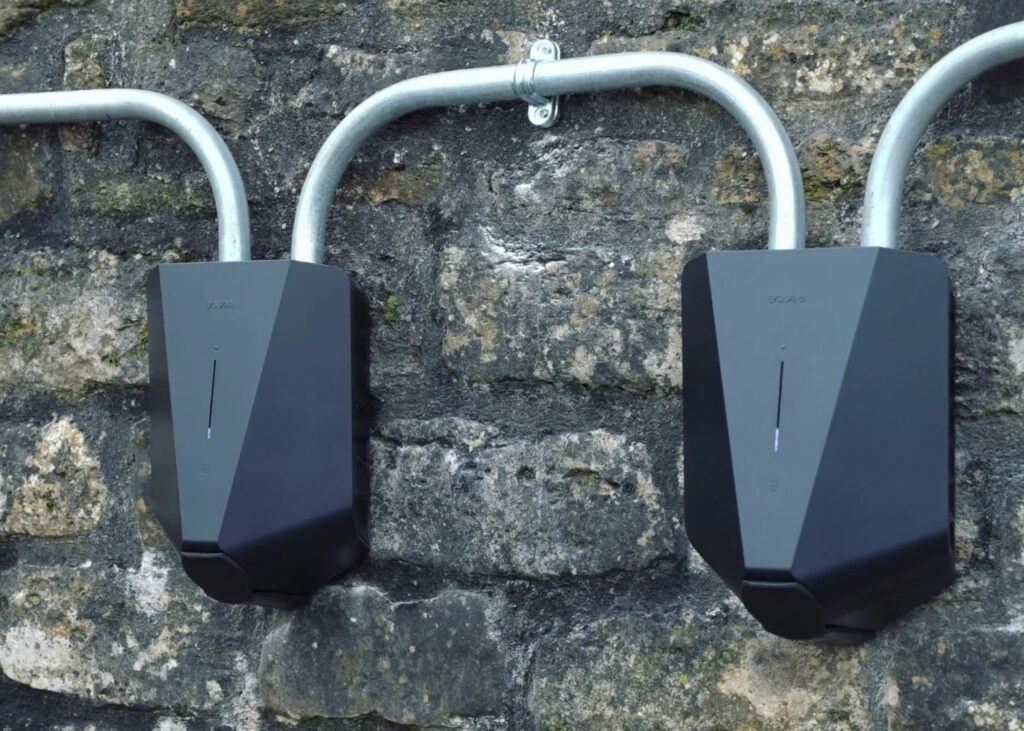
The image below shows two Easee One chargers in series:
The charger supports solar charging via the Easee Equalizer accessory. Without it, solar integration is not available.
Easee has sold over one million chargers globally since 2018. In September 2025, the full Easee range achieved EU Radio Equipment Directive (RED) cybersecurity compliance, certified by DEKRA to the EN 18031 standard.
If you’re looking at the Easee One because it’s untethered, check out our article comparing three Type 2 charging cables from Cord, Voldt, and Top Charger.
Rating: 4.4/5
Price when reviewed: From £999 with installation (no OZEV).
Last updated: February 2026. First published: September 2022.
Easee One Charger
Summary
The Easee One is a solid home charger with RFID, a lifetime 4G eSIM and a good app. You plug in, charge and go with scheduled charging. It’s a charger that works tethered and untethered out of the box, runs up to three charging points from one fuse, and covers the basics well. Solar charging is available with the Easee Equalizer accessory. Overall, it’s highly recommendable.
Pros
- Stylish design
- RFID included
- Integrated eSIM with lifetime 4G
- Tethered and untethered from one unit
- Scheduled charging
- Up to 3 charging points on one fuse
- Solar charging available via Easee Equalizer
Cons
- Solar charging requires the Easee Equalizer accessory (additional cost)
- LED status lights take some getting used to (a status screen would be a welcome addition)
- App data can take a few minutes to sync
Key features of the Easee One charger
- Tethered and untethered from one unit: The lockable Type 2 port lets you permanently attach a cable or remove it after each charge. Most chargers require you to choose one or the other at the point of purchase, so this is a useful feature for households that want flexibility.
- Multi-vehicle charging: Up to three Easee One units can operate from a single 32A fuse using built-in wireless load balancing. Secondary units connect to the main charger and share the available power automatically, removing the need for separate electrical circuits for each charging point.
- Solar charging via Easee Equalizer: The Easee One supports solar charging, but only when paired with the Easee Equalizer accessory. Once added, the charger can prioritise excess solar generation or blend solar and grid power depending on availability.
- Lifetime 4G connectivity: The integrated eSIM provides 4G connectivity with no subscription. Wi-Fi 2.4GHz is also supported as a backup, useful in areas with poor mobile signal.
- Cybersecurity certification: In September 2025, the Easee One achieved EU Radio Equipment Directive (RED) cybersecurity compliance, certified by DEKRA to the EN 18031 standard. This covers protection against unauthorised access, secure firmware updates, and data encryption. Find out more here.
Quick review
The Easee One is the only home charger that works tethered and untethered out of the box, and the only one that runs up to three charging points from a single fuse. For households with more than one electric vehicle, or those who haven’t yet decided how they want to run their cable, it sidesteps two of the most common decisions new EV owners face.
At 7.4kW on a single phase, it delivers around 28 to 30 miles of range per hour. That’s sufficient for most overnight charging, and the scheduling feature means you can set it to charge during off-peak hours without thinking about it.
The app is clean and covers the essentials well. RFID is built in, the eSIM means no Wi-Fi setup headaches, and the three-year warranty provides reasonable peace of mind. Solar charging is supported through the Easee Equalizer accessory, which is worth knowing about if you have panels.
Overall, the Easee One is an excellent smart home charger. The only owners who might look elsewhere are those wanting integrated solar charging without an additional accessory.
How easy is the Easee One to install?
The Easee One has been designed specifically to comply with UK regulations, including clause 722.411.4.1 of BS 7671:2018 A1. It includes integrated open PEN conductor protection, meaning no earth rod is required, and integrated RCD Type-B protection covering both AC and DC faults. It is compatible across TT, TN-S, TN-C and TN-C-S networks, with the network type detected automatically.
Built-in protection includes:
- Integrated overload protection
- Integrated broken PEN lead protection (BS 7671:2018/A1:2020)
- Built-in RCD: 30mA AC / 6mA DC ground fault protection, automatically tested between each session or at least every 24 hours
- Temperature monitoring across all main contacts
The Easee One can be installed as a single charging unit, delivering up to 7.4kW via single-phase 32A. It can also be paired with up to two further units on the same circuit, which communicate wirelessly to share available power without overloading the supply. If you need to balance load against the rest of the property’s consumption, adding the Easee Equalizer enables dynamic load balancing across the whole installation.
The circuit can be fused up to 40A, providing the maximum short-circuit current of 10kA is not exceeded. It is good practice to install an RCD Type A in the fuse cabinet to protect the installation supplying the charging units, though the integrated Type B RCD already covers the charger itself.
The Easee One comes with a pre-configured backplate with all terminals in place. Wiring requires stripping the cable core by 12mm and connecting to the terminals. Screw terminals require a torque of 5Nm. The charger supports cable cross-sections from 2.5 to 16mm² and cable diameters from 8 to 22mm.

Once wired, the Easee One creates its own Wi-Fi hotspot via the integrated eSIM. Hold the touch button to activate hotspot mode, connect your smartphone, and configure via the Easee Installer App (NFC or Bluetooth required). Configuration requires a PIN code found on the front of the unit, which the installer should transfer to the fuse cabinet for safe keeping.
Overall, the Easee One is straightforward to install for any competent electrician. The backplate, terminals and circuitry are all of a good standard, and the absence of an earth rod requirement keeps the installation neater than many alternatives.
Easee One design
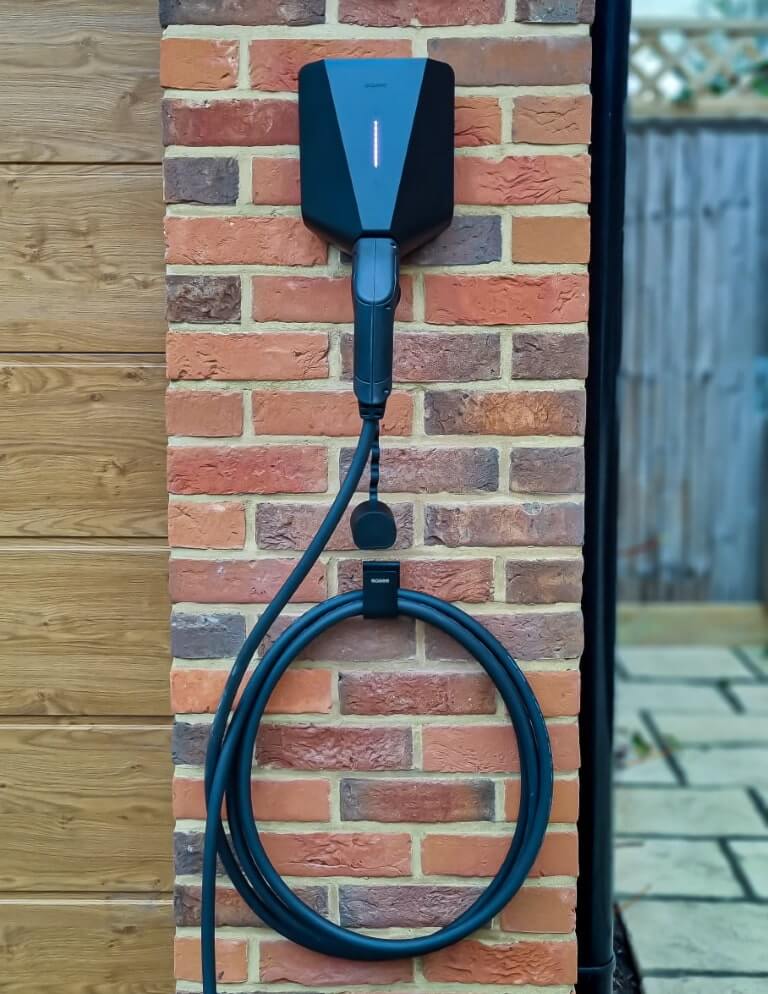
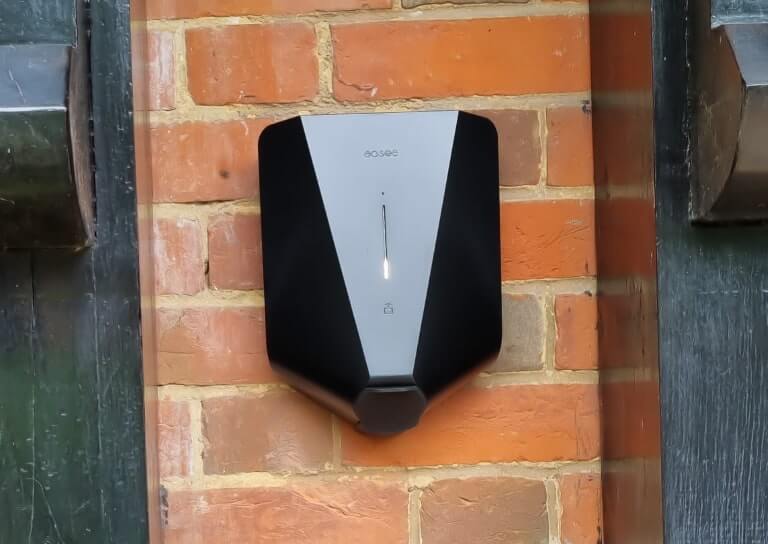
The Easee One is one of the better-looking home chargers available. Measuring 256 x 193 x 106mm and weighing 1.5kg, it sits comfortably on the wall without dominating it. The matte finish and angled casing give it a premium feel, and Easee offer additional colour faceplates if the standard options don’t suit.

The front of the unit has an LED light strip showing charger status and a touch button for manual controls. The design is clean and unfussy, which suits it well.
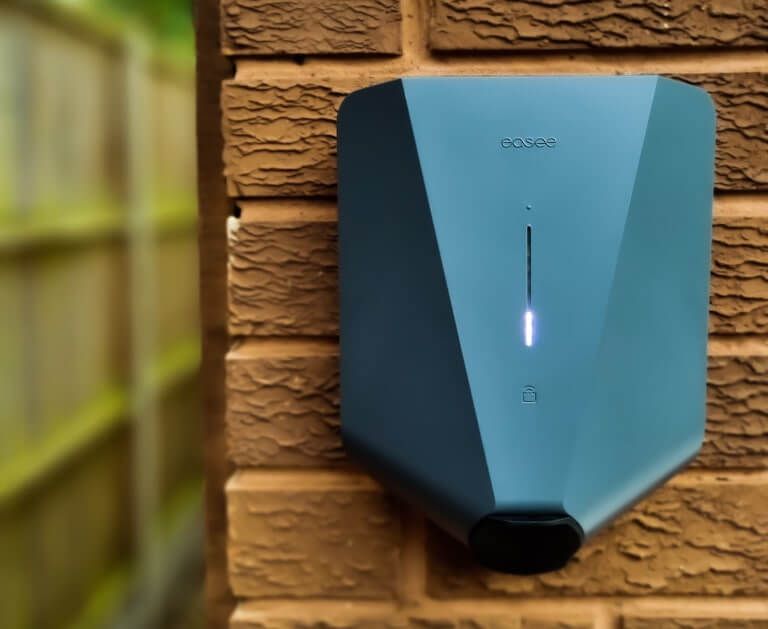
The standout design feature is the lockable cable mount, which lets you switch between tethered and untethered operation without any hardware changes. It is well executed and feels robust in use.
Build quality is solid. The Easee One holds firm when plugging and unplugging a cable, with no movement in the unit itself. The charger body isn’t shaped for cable looping, so a separate hook or holder is useful. Easee sell one separately, and we’ve covered a few options in our EV cable holders guide.

The only design improvement worth noting would be a small status screen. The LED strip communicates well enough, but a display would reduce the need to open the app just to check what’s happening.
Charging experience
The Easee One is a smart charger with scheduling and max power modes. You can set it to charge at a specific time, pause mid-session, or let it run as soon as a car connects. All of these work reliably in practice.
The cable port locks the cable in place at the click of a button from the app, creating a tethered setup. Remove the cable after charging and it becomes untethered. It works well and feels robust.

At 7.4kW, the Easee One adds around 28 to 30 miles of range per hour. For most drivers, overnight charging means a full battery every morning, so the charging speed is more than adequate for everyday use.

One thing to note on cost tracking: the app lets you log your electricity rate to estimate session costs, but it only accepts a single price per kWh. If you’re on a time-of-use tariff with separate peak and off-peak rates, the cost figures will be approximate.
You can use the scheduling feature to ensure charging falls within your off-peak window, but the cost display won’t automatically account for both rates. Our EV charging cost calculator will help you determine how much topping up will be.
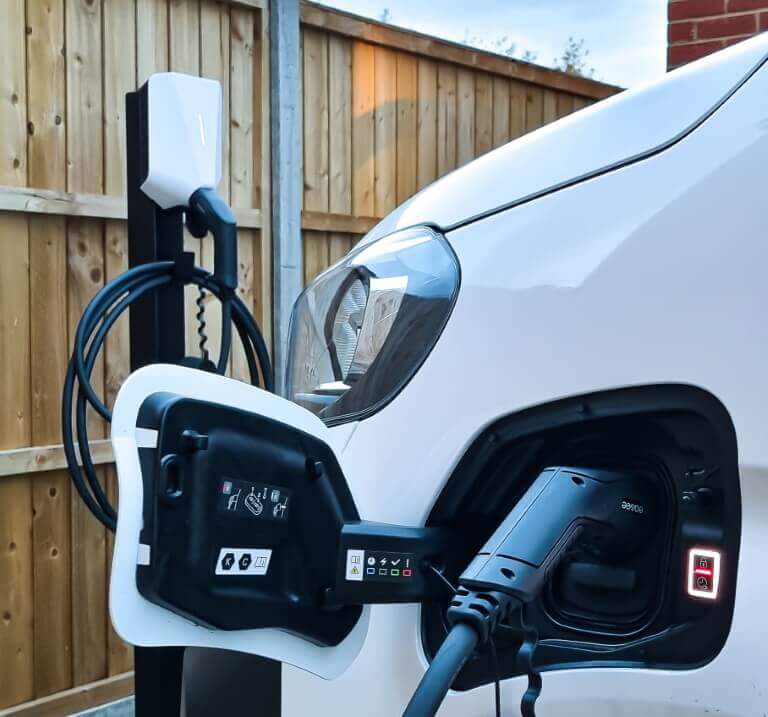
RFID tags, called Easee Keys, can be used to lock and unlock the charger. You can configure the charger to only accept registered tags, which is useful for accessible installations such as front driveways or shared parking.
Overall, the Easee One is a pleasure to use.
LED light strip
The LED light strip provides charger status at a glance. There are multiple light modes:
- Solid white at the bottom only (2 LEDs on master, 1 on secondary) – Standby
- Solid white full – car connected
- Pulsating white – charging in progress
- Blue constant – smart charging enabled
- Blue pulsating – smart charging in progress
- Flashing green (one or more LEDs) – software update in progress
- White flashing – awaiting RFID authentication
- White fast flashing – RFID tag received, awaiting key verification
- Red constant – general error (unplug and replug cable; if it persists, check the app)
- Red constant with warning sounds – broken PEN lead detected or wiring fault
- Red flashing with warning sounds – critical error; charger must be replaced
- Red pulsating – abnormal temperature, charger in safe mode
- White flashing at bottom only – secondary unit searching for master
- Yellow flashing at bottom only – charger awaiting configuration
It takes a little time to learn what each combination means. A small status screen would make this more intuitive, but it isn’t a significant issue in day-to-day use. Full LED reference guide on the Easee support site.
Tethered or untethered
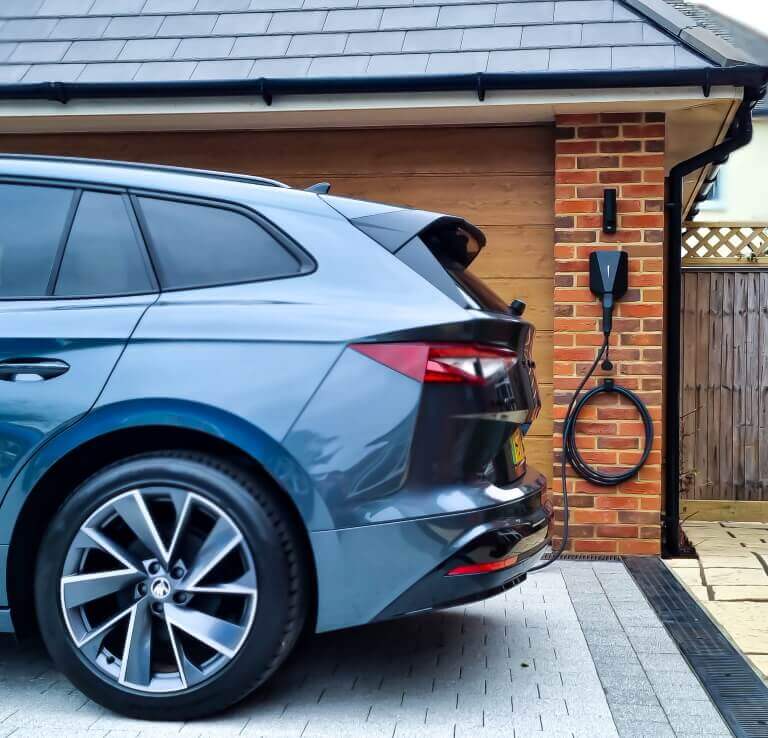
The Easee One accepts any Type 2 cable and lets you lock the cable in place via the app, creating a tethered setup. Remove the cable after charging and it functions as an untethered charger. Most chargers require you to decide at the point of purchase, so the ability to switch between the two without any hardware changes is one of the Easee One’s most useful features.
As we cover in our tethered vs untethered charger guide, tethered setups are more convenient day-to-day, while untethered looks tidier when the car isn’t plugged in. With the Easee One, you don’t have to commit to either.
If you do need a Type 2 cable for your Easee One, Top Charger sells one:


Type 2 to Type 2 Cable | 4-in-1 Bundle
7m cable, carry case, port cover & cloth. UKCA certified. 3-year warranty. £106.99.
“Cable is fantastic quality, really can’t believe how much better it is than the one that came with my car.” — Aaron
RFID reader

The RFID reader is integrated into the front of the charger. You can use an Easee Key (RFID tag or card) to lock and unlock the charger and activate charging sessions. The charger can be configured to only accept registered tags, preventing unauthorised use. This is particularly useful for chargers in accessible locations such as shared driveways or front gardens. The reader supports NFC, ISO 14443, and MIFARE Classic.
Up to 3 chargers on 1 fuse
Up to three Easee One units can run from a single 32A electrical supply. The second and third units are secondary units that connect to the main charger via the built-in Easee Link wireless communication. The total load across all units is automatically balanced and will never exceed the fuse rating.
In practice, if two chargers are running simultaneously from a 32A supply, each draws up to 16A (3.7kW). For overnight charging, this is more than sufficient. The main benefit is avoiding the cost and disruption of running separate electrical circuits for each charging point, or upgrading the consumer unit.
If you need to balance charging load against the rest of the property’s electricity consumption, the Easee Equalizer can be added for dynamic load balancing across the whole installation.
Solar charging and the Easee Equalizer
The Easee One supports solar charging, but this requires the Easee Equalizer accessory. Without it, solar integration is not available.
Once the Equalizer is installed, two solar modes become available through the app:
- Solar only: The charger only draws power when your panels are generating at least 1.4kW of excess energy. Your car charges slowly or intermittently depending on conditions, but draws nothing from the grid.
- Grid + Solar: The charger prioritises excess solar generation but supplements from the grid when solar output falls below 1.4kW, ensuring more consistent charging.
The Equalizer also enables dynamic load balancing across the full property, which is useful if you want to avoid tripping the main fuse when the charger, oven, and other heavy loads run simultaneously.
If solar integration is a priority and you’d prefer it built in without an additional accessory, the Hypervolt Home 3 Pro or Indra Smart PRO are worth considering.
Connectivity
The Easee One includes an integrated eSIM (LTE Cat M1) with a lifetime 4G subscription, meaning there are no ongoing data costs and no reliance on your home Wi-Fi for the charger to function. In areas with poor mobile signal, Wi-Fi 2.4GHz is also supported as a backup.
Additional connectivity options include Bluetooth BLE 4.2 for local operation when internet access is unavailable, Easee Link RF for communication between multiple chargers, and OCPP 1.6J via API for integration with third-party charge management platforms. The charger also supports an open API.
We had no issues with the 4G connection during testing. If you find the app connection inconsistent, switching to Wi-Fi tends to improve reliability.
Easee app
The Easee app is clean, well designed, and straightforward to navigate. It works well for most everyday charging needs, and is a step above the more rudimentary apps that come with some other chargers.

From the home screen you can see the current charge status, adjust LED brightness, lock or unlock the cable (switching between tethered and untethered mode), and set a charging schedule. The session data is detailed, covering power draw, current, voltage, kWh per session, lifetime totals, and monthly breakdowns.

One limitation worth knowing about: the app accepts a single electricity price per kWh for cost tracking. If you’re on a time-of-use tariff with peak and off-peak rates, the session cost figures will not be accurate unless you manually update the rate. The scheduling feature works well to ensure charging happens during your cheapest window, but the cost display itself doesn’t account for variable rates.
We experienced occasional connectivity delays during testing, where the app took a few minutes to sync or briefly showed the charger as offline. These weren’t persistent issues and connecting via Wi-Fi rather than 4G improved consistency. Overall, the app is more than adequate and Easee continue to issue regular updates.
Firmware updates
Firmware updates are delivered over the air via the Easee app. The car must be disconnected before an update can complete, and updates can take up to 30 minutes. Easee issues updates regularly, which is reassuring for ongoing product support.
Warranty
The Easee One comes with a three-year manufacturer’s warranty. Warranty claims are handled by Easee, with work carried out by approved installers. As with any charger, the circuit board and electrical components are the parts most likely to require attention outside the warranty period.
Easee One verdict
The Easee One is a well-rounded home charger that handles the things that matter most without making them complicated. The tethered/untethered flexibility, multi-unit load balancing, RFID access control, and lifetime 4G connectivity are all features other chargers charge a premium for or don’t offer at all. Here, they come as standard.

The design is one of the better ones on the market, the installation is straightforward for a competent electrician, and the app does what it needs to. Solar charging is available via the Easee Equalizer, so it’s not a closed door for solar owners, but it does involve an additional purchase and installation.
If you want a home charger that covers all the basics well, works for one or multiple EVs, and doesn’t require much thought once it’s installed, the Easee One is a strong choice. It scores 4.4/5.
Who should consider the Easee One
The Easee One works well for households with more than one electric vehicle. Running up to three charging points from one electrical supply avoids the cost of separate circuits or consumer unit upgrades, and the built-in load balancing manages power distribution automatically.
It’s also a good fit for anyone who hasn’t decided between tethered and untethered operation. The lockable cable port means you can try both and change your preference at any time.
For solar panel owners, the Easee One does support solar charging via the Easee Equalizer accessory. If you’d prefer solar integration built into the charger itself without an additional device, the Hypervolt Home 3 Pro or Indra Smart PRO are worth a look.
The RFID access control makes it a sensible option for chargers in accessible locations such as shared driveways or front gardens, where you want to prevent unauthorised use.
Specifications
- Power output: 1.4 to 7.4kW (single-phase, 6A to 32A, automatically adjusted)
- Cable: Lockable Type 2 port (tethered or untethered, IEC 62196-2)
- Voltage: 230V AC (±10%), single phase
- Connectivity: Integrated eSIM (LTE Cat M1, lifetime subscription), Wi-Fi 2.4GHz, Bluetooth BLE 4.2, OCPP 1.6J, open API
- Protection: Integrated RCD (30mA AC / 6mA DC), open PEN protection, overload protection, temperature monitoring
- Smart features: Scheduling, RFID access control (NFC / ISO 14443 / MIFARE Classic), load balancing, OTA firmware updates
- Multi-vehicle: Up to 3 units on one 32A fuse
- Solar: Supported via Easee Equalizer accessory
- Dimensions: 256 x 193 x 106mm (H x W x D)
- Weight: 1.5kg
- Operating temperature: -30°C to +40°C
- Ingress protection: IP54
- Impact resistance: IK10
- Installation network: TT, TN-S, TN-C, TN-C-S (auto-detected)
- Cable cross-section: 2.5 to 16mm²
- Warranty: 3 years
- Price: From £999 with installation
- Certifications: EN 18031 (EU RED cybersecurity), BS 7671:2018 A1, EV Smart Charge Points Regulations 2021, CE, RoHS, EMC, LVD
Easee One documentation
Easee One FAQs
This review was produced in collaboration with Vanadium, OZEV-approved national installers of Easee chargers. We extend our thanks to Vanadium for the photos used in this review. Be sure to visit them if you like what you see!
