


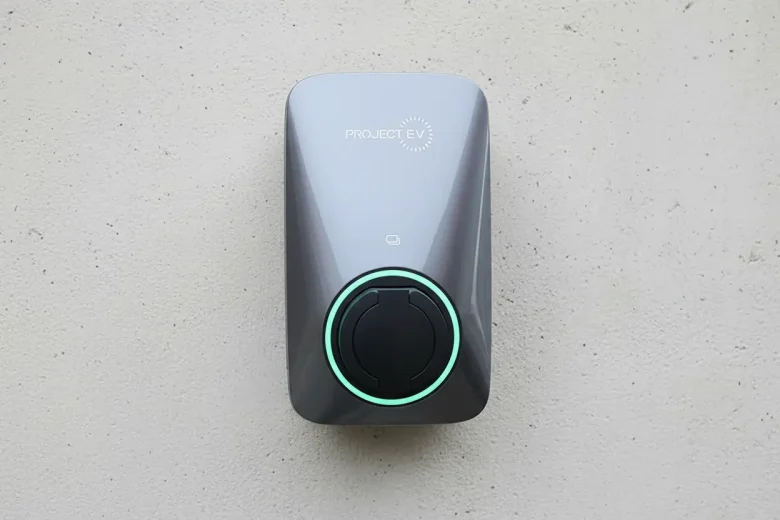


Our first hands-on review of a Project charger was in 2022 for the Pro Earth. It wasn’t the best home charger back then but a lot has changed since. Project EV now sells the Apex for your home and a whole bunch more for car parks and the like. It gets decent chatter among the electricians we speak to. What’s what, then?
If you’ve searched “Project charger” and landed here, you’re likely looking at one of their home AC units. This guide covers the full Project EV AC range, what each model includes, and which one suits your situation.
What is a Project EV charger?
Project EV makes smart EV charge points. All AC chargers in the range are IP65 rated, protecting them against dust and low-pressure water jets. Every unit includes onboard RCBO isolation as standard and comes with a five-year warranty.
The range splits into two power outputs, 7.3kW and 22kW, with options for wall-mounted and floor-standing, single and dual outlet, and various connectivity configurations.
The 7.3kW Apex range
The Apex is Project EV’s 7.3kW single-phase home charger. At 7.3kW on a single phase, it delivers around 25 to 30 miles of range per hour, which is enough to top up overnight. The 7.3kW Apex range includes five models.
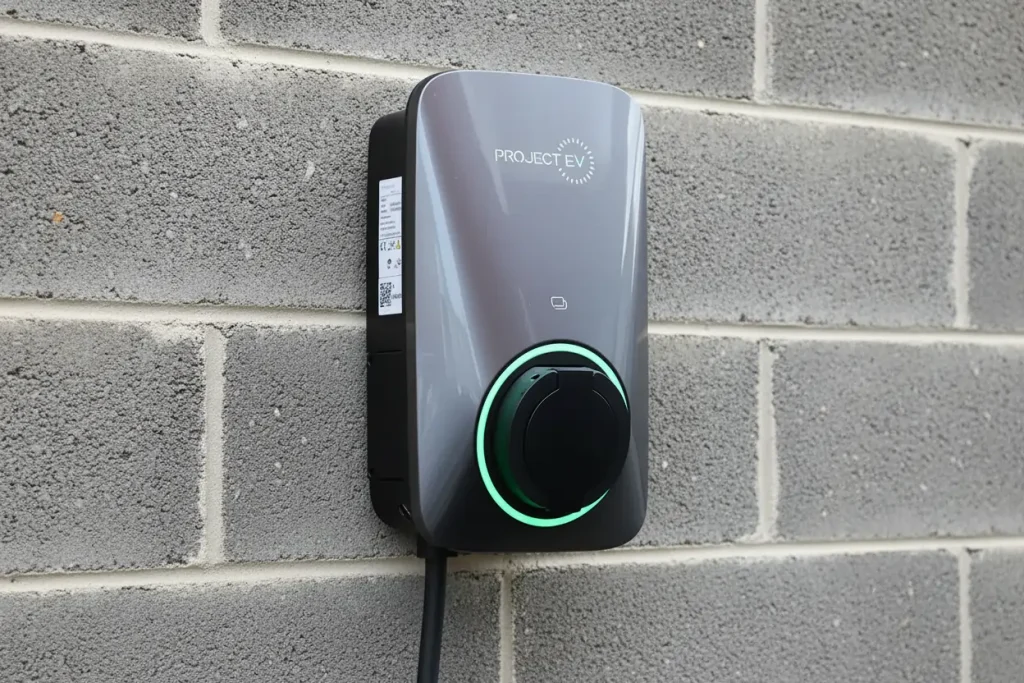
EVA-07S-S is the base untethered model. It has a Type 2 socket but no RFID and no 4G. If you need a Type 2 charging cable, click the link for our comparison piece.
EVA-07S-SE adds Pro Earth, which removes the need for an earth spike during installation at this site. This reduces installation complexity and cost.
EVA-07S-SE-RFID includes Pro Earth and an RFID reader. You use an RFID card or fob to start and stop charging sessions. This is useful if the charger is in an accessible location such as a front driveway.
EVA-07S-SE-RFID-4G adds built-in 4G connectivity on top of Pro Earth and RFID. The charger stays online without relying on your home Wi-Fi.
EVA-07S-PE-RFID is a Pro Earth model with RFID, sitting within the Pro Earth line alongside the SE-RFID variant.
All 7.3kW Apex models support solar charging and dynamic load balancing through the Project EV app. Check out our best EV chargers article for more wall boxes that support solar.
Project EV Apex prices start from around £277 ex. VAT for the base untethered model. The tethered RFID model is around £392 ex. VAT and the 4G RFID model around £399 ex. VAT. Add roughly £500 for a standard home installation. All prices are ex. VAT and vary by retailer.
Now’s the time to buy, anyway. The government has increased home charger installation grants to £500, up from £350. The new rate takes effect on 1 April 2026 and runs until March 2027.
The 22kW Apex and Novo range
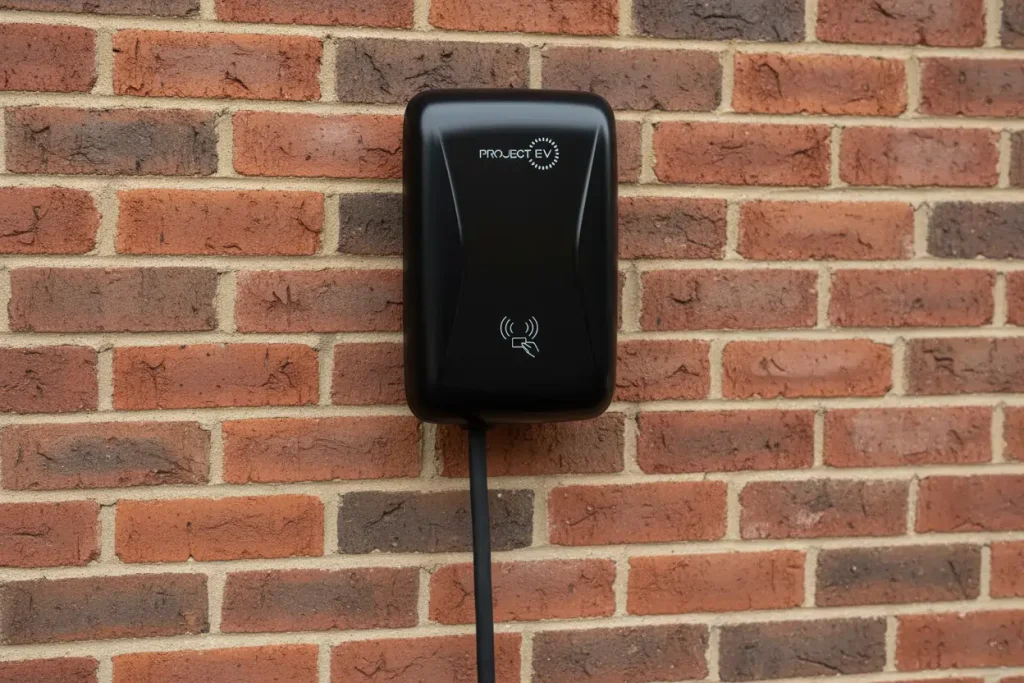
The 22kW range requires a three-phase electricity supply. Most UK homes are single-phase, so these units are more common in commercial settings or properties with a three-phase connection.
Apex 22kW is the three-phase version of the Apex for faster charging where the supply is available.
Novo EVA-22S-SE is a 22kW wall charger with Pro Earth.
Dual outlet models
Project EV makes dual outlet chargers for charging two vehicles at the same time. These come in wall-mounted and floor-standing versions.
Wall-mounted dual (EVA-07D-SE-W and EVA-22D-SE-W) are Pro Earth dual chargers in 7kW and 22kW, with two Type 2 outlets.
Floor-standing dual with RFID (EVA-07D-SE-RFID and EVA-22D-SE-RFID) are pedestal units with two outlets and RFID access control. These suit car parks, workplaces, and commercial installations.
Features across the range
Pro Earth removes the need for an earth spike during installation. It applies to SE models only. Your installer will confirm whether your property requires it, but it typically reduces the work and cost involved.
Solar charging is supported on all single-gun AC models through the Project EV app. The charger can prioritise solar generation or blend solar and grid power depending on availability.
Dynamic load balancing is included on all AC models. It distributes available power across your household to prevent tripping your supply when other appliances are running.
Cable lock secures your charging cable to the charge point and your vehicle on untethered models.
RFID access control is available on RFID-suffix models. It prevents unauthorised use and is useful for chargers in accessible or shared locations.
4G connectivity is available on the EVA-07S-SE-RFID-4G. It keeps the charger online without any router configuration.
The Project EV app
The Project EV app is free. It lets you set charging schedules, adjust charging rates, enable solar mode, and view session records. There is also a Pro App for commercial operators managing multiple charge points across sites.
The Project charger app ecosystem does get pretty miserable ratings, ahtough. You’re looking at 1.6/5 on the App Store for iPhone. On Google Play, its APEX EV app gets 2/5. Customers HATE (with capitals) the apps despite the decent hardware.
Which Project EV charger should you buy?
For most home users, the decision comes down to three questions.
Do you need Pro Earth? If your installer recommends it, or you want to avoid the cost of an earth spike, choose an SE model.
Do you want RFID? If the charger will be visible from the street or on a shared driveway, RFID stops others from using it. The EVA-07S-SE-RFID is the most common choice for home installs in accessible locations.
Is your Wi-Fi unreliable near the charger? The EVA-07S-SE-RFID-4G avoids the issue without any router setup.
For two vehicles, look at the dual wall models. For commercial or workplace installs, the floor-standing RFID units are the better fit.
If you need an untethered charger, also consider how you’ll store your cable. EV cable wall mounts are perfect for keeping everything tidy.
Project EV charger installation
Project EV chargers must be installed by a qualified electrician. All AC models comply with 18th Edition wiring regulations. The Pro Earth models remove the earth spike requirement, which simplifies installation on most domestic properties.
Specifications (7.3kW Apex AC models)
| Power output | 7.3kW (32A, single-phase) |
| Connector | Type 2 (IEC 62196-2) |
| Ingress protection | IP65 |
| Warranty | 5 years |
| Protection | Onboard RCBO isolation |
| Smart features | Scheduling, solar mode, load balancing, RFID (selected models), 4G (selected models) |
| Compliance | 18th Edition wiring regulations |
