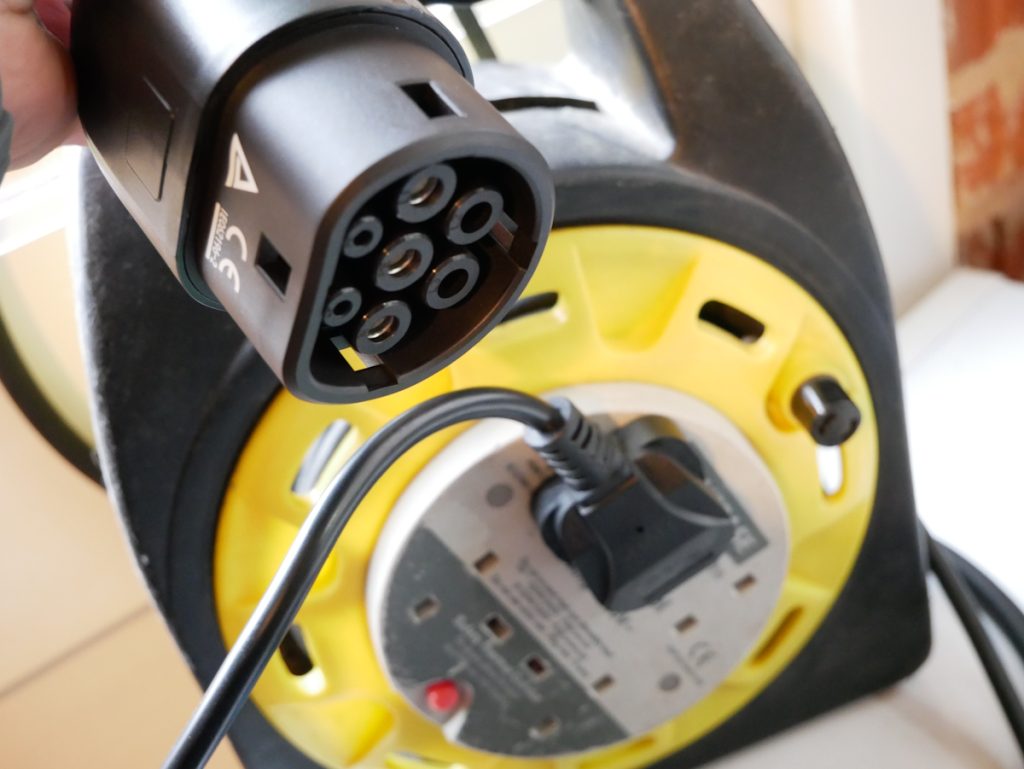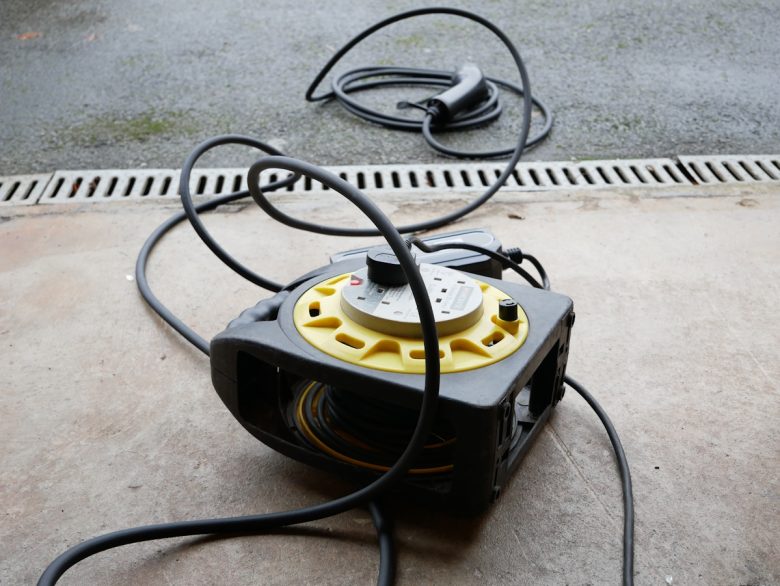


Charging your electric vehicle with a standard extension lead poses fire and safety risks and is not recommended for extended periods, especially overnight. If you have no alternative, use it only as a temporary, last-resort solution. Make sure the cable is heavy-duty and outdoor-rated, fully uncoiled, and monitor it regularly for signs of overheating.
The answer is yes to can you use an extension lead to charge an electric car, but no in terms of it being completely safe. Safety depends on three factors you need to know about:
- The quality of your extension lead
- The quality of the socket you’re plugging your extension lead into
- The quality of the 3-pin portable charger you’re plugging into the extension lead
That’s three devices you need oversight over. Why the oversight? Because there’s a risk to using an extension lead for EV charging, which is overpowering any of these devices or drawing too much current, and thus generating too much heat, which could cause a fire.
Let’s break these components down:
- The wall socket: These are rated for 13A by default. You can’t get any higher than that. It is safest to use a brand new socket. It goes without saying it should be installed, or should have been originally installed, by a qualified electrician.
- The extension lead: It should match the wall socket rating, 13A. There’s no point in looking for any extension leads rated more than that, the socket only draws that much, but you can if you want. Your extension lead should have a thermal cut-out, a built-in safety mechanism that automatically cuts the power if the cable overheats, preventing fires. Less cable is better here, so you don’t need to coil it as much. So, if you need 15m, buy 15m and not 20m.
- The 3-pin portable charger: It should have a UKCA or CE marking. The key standards are IEC 61851-1 (Mode 2 charging system requirements), IEC 62752 (in-cable control and protection device), and IEC 62196-2 (AC connector/plug requirements). It doesn’t matter if it’s made in China, Taiwan, Europe, the US, or Britain, it needs to meet those requirements.
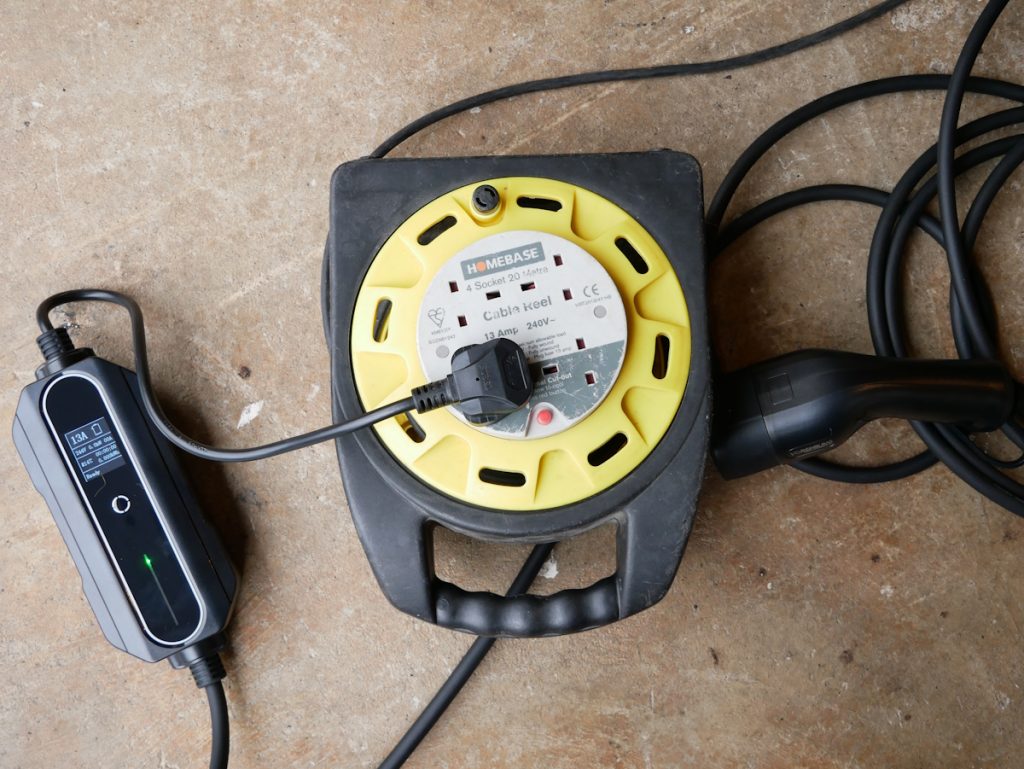
Do not buy the cheapest product. Our experience is the cheapest products are poorly made, especially in the case of portable EV chargers. Budget £200 for a 5m portable charger and at least £50 for an extension cable in the length you need.
The table below provides all the specifications you need to pick a suitable EV charger extension cable:
| Feature | Minimum requirement | Recommended | Why it matters |
|---|---|---|---|
| Amperage rating | 13A | 13A | Anything below 13A will overheat with sustained EV charging loads |
| Cable length | As short as possible | 10m-20m | Longer cables increase voltage drop and resistance; choose shortest length that reaches |
| Thermal cut-out | Essential | Essential with LED indicator | Automatically disconnects power if cable overheats, preventing fire risk |
| Cable gauge | 1.5mm² | 2.5mm² | Thicker cable handles higher current with less heat generation |
| Outdoor rating | IP44 minimum | IP54-IP65 | Protection against rain, splashes, and moisture for safe outdoor use |
| Socket type | 13A socket | 13A single socket or multiple if you’re happy sharing the load | Multiple sockets add convenience; shuttered sockets prevent debris/water entry |
| Cable management | Fully unwindable | Reel with stand/wall mount | Must be fully unwound during use; reels make storage easier |
| Overload protection | Fused plug (standard) | Fused + RCD protection | Prevents electrical overload and provides earth leakage protection |
| Certification | BS 1363 (plug) | BS EN 61242 + BS 1363 | Ensures product meets UK safety standards for cable reels |
| UV resistance | Basic | UV-stabilised outer sheath | Prevents cable degradation from sun exposure over time |
| Warranty | 12 months | 12 months | Indicates manufacturer confidence in quality and durability |
| Socket cover | None | Hinged weatherproof cover | Protects unused sockets from moisture and debris |
Key takeaway: Never compromise on amperage rating (must be 13A minimum) or thermal cut-out protection – these are non-negotiable safety features for EV charging.
The fire risk
Extension cables and EV charging are not a combination that manufacturers endorse with enthusiasm. The problem is heat. Most extension cables were not built to carry current for the six, eight, or ten hours it takes to charge a car. A 3-pin socket was not designed for it either. It will work. But it was built for kettles, not for overnight loads.
If you are unsure about a product, contact the manufacturer before plugging in. Some EV makers, BMW among them, tell customers not to use extension cables at all. So can you plug car charger into extension cord and expect it to be safe? Only if the cord is built for the job.
Finding an extension lead suitable for EV charging
The best extension lead for EV charging is one rated for 13A with multi-stranded copper cores, built-in circuit protection, and an IP rating for use outdoors. The 13A rating gives you margin over the charger’s 10A draw, and that margin matters when a cable is under load for hours.
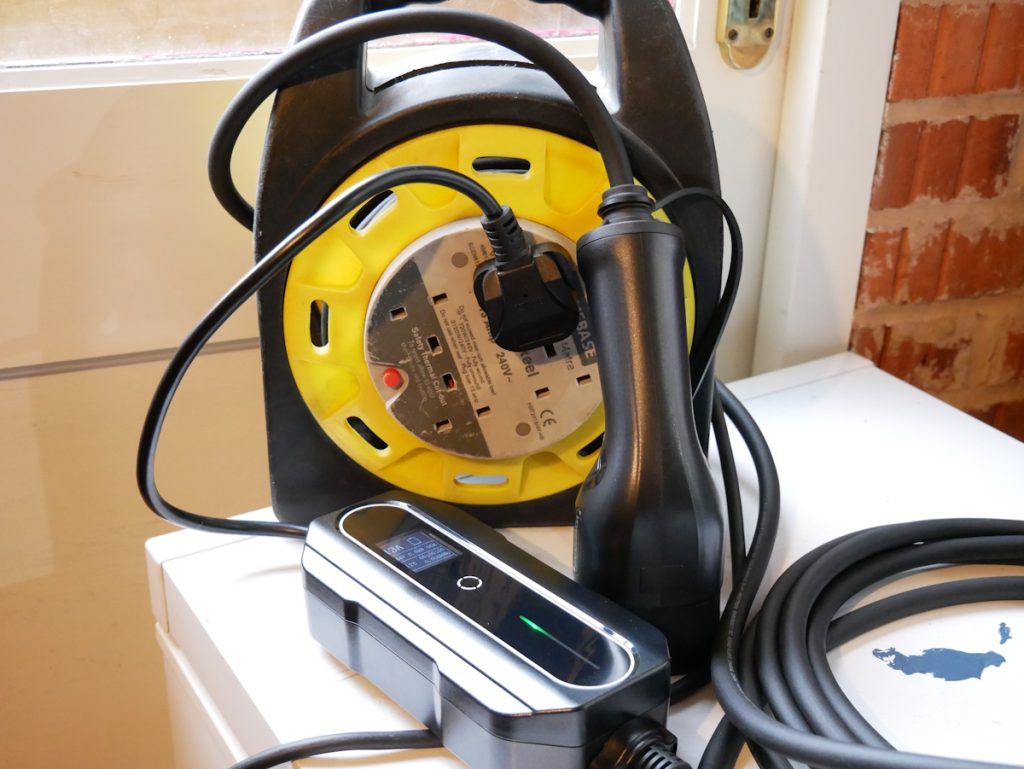
Choose the shortest length that will reach your car. Every metre of cable adds resistance, and resistance means voltage drop. If the cable comes on a reel, you must uncoil it before use. A coiled cable traps heat and creates a fire risk.
Charging speeds
Most 3-pin granny chargers draw 10A and deliver between 2.3kW and 2.4kW. The socket itself can handle up to 3kW at 13A, but the charger limits the draw to 10A for safety. At that rate, you get roughly 8 miles of range per hour. Over eight hours, you will add around 60 miles. That may be enough for your commute. It will not fill a battery from empty.
For faster speeds, get an electrician to install one of the following:
- A 16A commando socket, which charges at 3.6kW and adds about 15 miles of range per hour.
- A 32A charger, which delivers up to 7.4kW and adds about 30 miles of range per hour
Can I charge my EV overnight with an extension lead?
We don’t recommend it with an extension lead because drawing that much current for so long can cause overheating of the socket and extension lead. If you must, use a 13A extension lead, uncoil it, and monitor the setup before you go to bed.
Consider a charger instead
A 3-pin socket and an extension cable will get the job done for temporary charging. But a charger mounted to your wall will do it faster, and it will let you schedule charge times to take advantage of off-peak electricity rates.
Two options worth looking at:
- Hypervolt Home 3 Pro. Works with solar panels. Has an app for scheduling.
- Ohme ePod. Untethered. The app lets you set price caps per kWh if you are on a tariff with rates that change through the day.
The rule
Use a 13A extension lead, designed for use outdoors, from a manufacturer you trust. Never use a multi-outlet strip. If you have doubts about the cable or the socket, don’t plug in.