


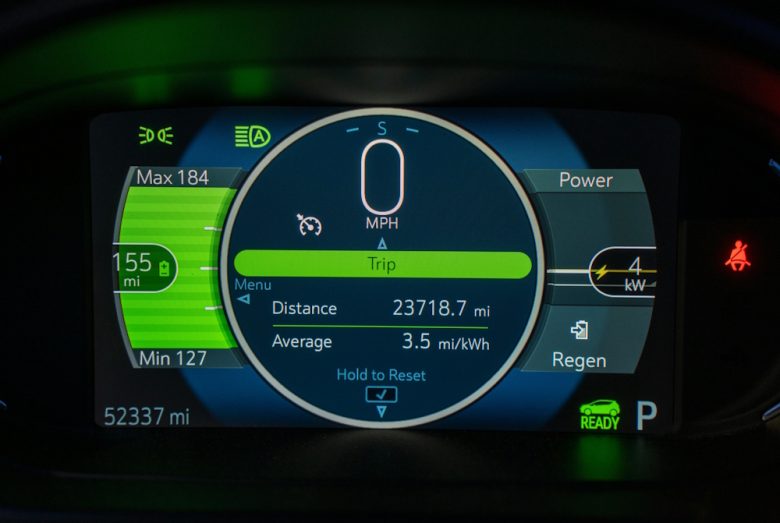


Your EV’s real-world range depends on a mix of factors, from how you drive and the weather outside to the age of the battery itself. The good news is that most drivers get within about 15% of the manufacturer’s estimated range, and much of the shortfall comes down to habits you can change.
Below, we break down what affects EV range, how to get the most from every charge, and what to expect from your battery as it ages.
What affects EV range?
Several factors influence how far your electric car will travel on a single charge. Some are fixed, like battery size and vehicle weight, while others are within your control.
| Factor | Effect on range | Can you control it? |
|---|---|---|
| Battery capacity | A larger battery stores more energy, giving you a longer range | No (chosen at purchase) |
| Driving style | Aggressive acceleration and harsh braking use more energy and reduce range | Yes |
| Speed | Higher speeds increase aerodynamic drag, which consumes more energy | Yes |
| Vehicle weight and load | A heavier vehicle or a full boot requires more energy to maintain speed | Partly |
| Climate control | Heating and air conditioning draw energy directly from the battery | Yes |
| Outside temperature | Cold weather reduces battery efficiency and increases heating demand | No (but you can mitigate it) |
| Tyre pressure | Under-inflated tyres create more rolling resistance, reducing efficiency | Yes |
| Terrain | Driving uphill uses significantly more energy than flat roads | Partly (route choice) |
| Battery age | Batteries gradually lose capacity over time, reducing maximum range | Partly (charging habits help) |
How does cold weather affect EV range?
Cold temperatures affect range in two ways. First, the battery’s internal chemistry becomes less efficient in low temperatures, meaning it delivers less usable energy per charge. Second, you are more likely to run the cabin heater, which draws energy directly from the battery rather than from waste engine heat (as in a petrol or diesel car).
The combined effect can reduce range by 20-30% in winter conditions, though the exact figure varies by model and driving conditions.
You can reduce the impact by pre-conditioning your car while it is still plugged in. This warms the battery and cabin using mains electricity rather than stored charge, so you set off with a warm battery and a comfortable interior without eating into your range. Most modern EVs let you schedule pre-conditioning through their app.
Driving habits that reduce range the most
If you are noticing your range dropping faster than expected, your driving style is likely the biggest factor. The habits that have the greatest negative impact are:
- Heavy acceleration: Flooring it away from traffic lights or junctions draws a large burst of energy from the battery. Smooth, gradual acceleration is far more efficient.
- Late, hard braking: While EVs recover some energy through regenerative braking, sharp braking at the last moment recovers less than gentle, early deceleration. Using your car’s regenerative braking mode (often called “one-pedal driving”) helps maximise energy recovery.
- Motorway speeds: Aerodynamic drag increases significantly above 60mph. Dropping from 70mph to 60mph on a long motorway journey can make a noticeable difference to your remaining range.
- Unnecessary climate control use: Running the heater or air conditioning at full blast when you do not need it wastes energy. Heated seats and steering wheels are more efficient than blasting the cabin heater, as they warm you directly rather than heating the entire interior.
- Carrying unnecessary weight: Roof boxes, heavy items in the boot, and bike racks all add drag or weight. Remove them when they are not in use.
How to get the most range from your EV
Most of these tips come down to smoother, more anticipatory driving:
- Accelerate gently and maintain a steady speed. Use cruise control on motorways and dual carriageways where it is safe to do so.
- Make the most of regenerative braking. Lift off the accelerator early and let the car slow itself, recovering energy in the process. Many EVs offer adjustable regeneration levels.
- Pre-condition your car while plugged in. Warming (or cooling) the cabin and battery before you unplug means you start your journey with a full, optimally-tempered battery.
- Plan your route. Use your car’s sat nav or an app like Zapmap to find the most efficient route, factoring in elevation changes and charging stops if needed.
- Keep your tyres at the correct pressure. Check them at least once a month. Under-inflated tyres increase rolling resistance and can quietly drain your range.
- Use heated seats over the cabin heater where possible. They use less energy and warm you more quickly.
Battery degradation: what to expect over time
Like all lithium-ion batteries, your EV’s battery will gradually lose some of its capacity over the years. This means the maximum range you can achieve on a full charge will slowly decrease.
The rate of degradation varies between manufacturers and models, but most real-world data suggests that a typical EV battery retains around 85-90% of its original capacity after five years of normal use. Some newer battery chemistries, such as lithium iron phosphate (LFP), are showing even better longevity.
Several factors influence how quickly your battery degrades:
- Frequent use of rapid chargers: Occasional rapid charging is fine, but relying on it exclusively can accelerate wear. Slower home charging is gentler on the battery.
- Regularly charging to 100% or draining to 0%: Keeping the battery between roughly 20% and 80% for daily driving reduces stress on the cells. Most EVs let you set a charge limit.
- Exposure to extreme temperatures: Prolonged heat is particularly hard on batteries. If you have the option, parking in shade or in a garage helps.
It is worth noting that most manufacturers offer a battery warranty of eight years or 100,000 miles (whichever comes first), typically guaranteeing at least 70% of original capacity. If your battery degrades beyond that threshold within the warranty period, the manufacturer is obliged to repair or replace it.
Some manufacturers are also beginning to offer battery upgrade or replacement programmes, allowing owners to fit a newer, higher-capacity battery to an existing vehicle, effectively extending its life and restoring lost range.
