

Updated January 2026
Looking for the best EV chargers for your home in 2025? Whether you need a smart charger to tap into cheap overnight rates, a compact unit that won’t dominate your wall space, or a powerhouse 3-phase charger, we’ve got you covered.
Choosing the right home charger isn’t just about picking the cheapest option. You’ll want to consider charging speeds, smart features, solar compatibility, and long-term reliability. With home charger installations now exceeding one million in the UK, the market has matured considerably, offering everything from budget-friendly options to premium solar-integrated systems.
This guide covers the best electric car chargers you can buy right now, including detailed reviews of eight top-performing models. We’ve analysed the latest Type 2 chargers, examined their smart capabilities, and broken down exactly what each offers for different user needs.
Best Smart EV Chargers
The best smart chargers offer remote control via smartphone apps, scheduled charging to exploit cheap overnight electricity rates, and real-time monitoring of energy usage and costs. Many now include solar integration, dynamic load balancing, and over-the-air software updates to keep your charger current as technology evolves.
1. Hypervolt Home 3 Pro

The Hypervolt Home 3 Pro delivers exceptional reliability combined with sleek aesthetics, making it our top pick for UK homeowners seeking a premium smart charging experience.
Key Specifications:
- Power Output: 7.4kW (single-phase)
- Charging Speed: Up to 30 miles of range per hour
- Cable Length: 5.0m standard (7.5m and 10.0m available)
- Connectivity: Wi-Fi and Ethernet
- Dimensions: 328mm x 243mm x 101mm
- Weight: 5.2kg
- Warranty: 3 years (extendable to 5 years)
- Protection Rating: IP66 (fully weatherproof)
- Impact Rating: IK10 (vandal-resistant)
What Makes It Stand Out:
The Hypervolt Home 3 Pro earns its premium positioning through exceptional reliability and outstanding customer support. UK-based Hypervolt has built a strong reputation since launching home chargers in 2021, with users consistently praising the company’s responsive service and comprehensive warranty coverage.
The charger’s polished design features an LED-backlit faceplate available in UltraWhite, UltraBlack, or Space Grey, housed in durable polycarbonate and nylon casing. The compact form factor takes up minimal wall space while delivering full 7.4kW charging capacity, adding around 30 miles of range per hour to most EVs.
Installation is straightforward thanks to streamlined rear-entry wiring and integrated PEN protection, eliminating the need for expensive earth rod installation. The unit supports both Type 2 cables and includes built-in DC residual current detection for complete electrical safety.
Through the intuitive Hypervolt app, you gain complete control over charging sessions. Switch seamlessly between Plug & Charge and Scheduled Charging modes to optimise costs based on your energy tariff. The app displays real-time usage statistics, historical data, and estimated costs.
Solar charging modes deserve special mention. The Home 3 Pro can maximise self-consumption from PV panels, automatically adjusting charging power based on excess generation. This feature alone can dramatically reduce charging costs for homeowners with solar installations.
Dynamic load balancing actively monitors household electrical consumption and adjusts charging power to prevent circuit overload. This intelligent system means you can charge your EV without worrying about tripping breakers when other high-power appliances are running.
The LED light ring provides instant charging status updates, pulsing different colours to indicate active charging, scheduled mode, or error conditions. Combined with the IP66 weatherproof rating and IK10 impact resistance, the Home 3 Pro is built to last in any UK weather condition.
Recent user feedback highlights exceptional reliability, with the charger performing flawlessly across diverse vehicle types from pure electric models to plug-in hybrids. The company’s UK-based support team provides quick assistance when needed, and the three-year warranty (extendable to five years) offers peace of mind. The only minor consideration is ensuring adequate Wi-Fi coverage at the installation location, though this is easily resolved with standard Wi-Fi extenders.
Best For: Homeowners seeking a premium, reliable charger with excellent solar integration and industry-leading customer support.
2. Ohme ePod
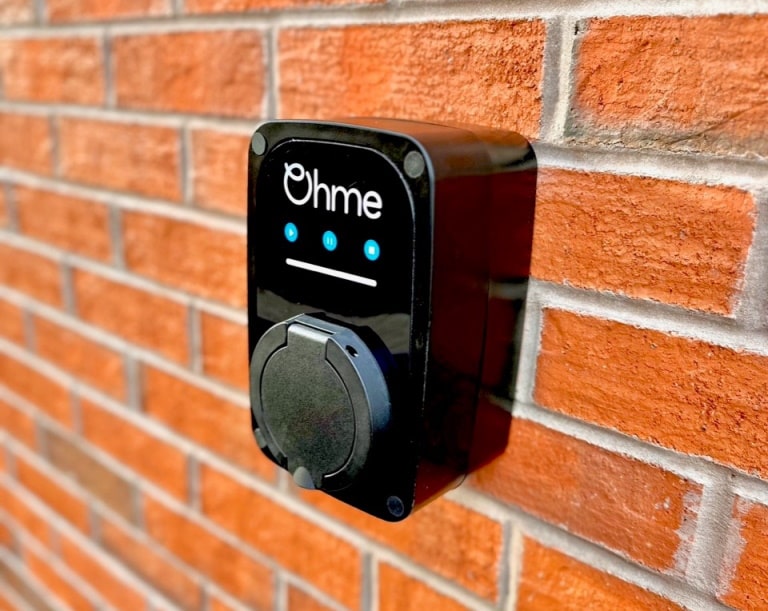
The Ohme ePod has an ultra-minimalist design and powerful smart features, delivering 7.4kW charging in a package 80% smaller than conventional chargers.
Key Specifications:
- Power Output: 7.4kW (32A max)
- Charging Speed: Up to 28 miles of range per hour
- Cable Type: Untethered (Type 2 socket)
- Connectivity: 3G/4G with included SIM card (3 years free)
- Dimensions: 230mm x 140mm x 100mm
- Weight: 1.5kg
- Warranty: 3 years
- Protection Rating: IP54
- Impact Rating: IK08
What Makes It Stand Out:
The Ohme ePod’s standout feature is its incredibly compact dimensions – at just 230mm tall and 140mm wide, it’s one of the smallest 7.4kW chargers available. This makes it ideal for homes where wall space is limited or where you want the charger to remain discreet.
Despite its diminutive size, the ePod packs serious functionality. Built-in 3G/4G connectivity via an included SIM card (covered by Ohme for three years) ensures reliable smart charging capabilities without depending on home Wi-Fi. This cellular connection enables the charger to automatically optimise charging times based on grid demand and electricity pricing.
Integration with energy tariffs like Octopus Agile and OVO represents the ePod’s killer feature. The charger automatically starts charging when electricity rates hit their lowest point, potentially saving hundreds of pounds annually. You can set price caps through the app, ensuring you never pay above a specified rate per kWh.
The Ohme app provides intuitive control over all charging functions. Schedule charging sessions, set target charge levels, monitor energy usage in real-time, and track historical costs. The interface is clean and straightforward, avoiding the complexity that plagues some competitor apps.
Physical operation is equally simple. Three interactive touch buttons on the charger allow you to start, stop, and pause sessions without reaching for your phone. The five-colour LED indication strip (green, blue, yellow, white, purple) clearly communicates charging status at a glance.
Installation benefits from multiple wiring entry points (rear or underside) and integrated PEN fault detection, eliminating earth rod requirements. The unit includes Type A RCD with built-in 6mA DC protection, simplifying electrical compliance.
Dynamic load balancing is available via an optional CT clamp, allowing the ePod to monitor household consumption and adjust charging power accordingly. This prevents circuit overload when multiple high-power appliances operate simultaneously.
The PC945 fire-rated enclosure (V-0 UL94) provides safety assurance, while over-the-air firmware updates keep the system current with the latest features and security patches. Operating temperature range of -25°C to 50°C ensures reliable performance through harsh UK winters.
Field performance demonstrates solid reliability with straightforward installation processes. The company’s UK-based support responds promptly to issues, with most repairs covered under warranty at no charge. The ePod’s untethered design means you use your vehicle’s charging cable, keeping the installation neat when not in use. This also provides flexibility if you change vehicles with different cable requirements.
Best For: Homeowners wanting a compact, set-and-forget charger with excellent energy tariff integration and minimal visual impact.
3. Wallbox Pulsar Max

Image via Wallbox
The Wallbox Pulsar Max combines Spanish engineering excellence with comprehensive smart features, delivering reliable 7.4kW charging in a remarkably lightweight package.
Key Specifications:
- Power Output: 7.4kW (single-phase), 11kW and 22kW options available
- Charging Speed: Up to 30 miles of range per hour
- Cable Length: 5.0m standard (7.0m optional)
- Connectivity: Wi-Fi and Bluetooth
- Dimensions: 198mm x 201mm x 99mm (without cable)
- Weight: 1.3kg (without cable)
- Warranty: 3 years
- Protection Rating: IP55
- Impact Rating: IK10
What Makes It Stand Out:
Wallbox, established in 2015 and now selling chargers in 117 countries, brings proven international expertise to the UK market. The Pulsar Max represents their most refined home charging solution, balancing advanced features with user-friendly operation.
At just 1.3kg without cable, the Pulsar Max is remarkably lightweight while maintaining IK10 impact resistance and IP55 weatherproofing. The compact dimensions (198mm x 201mm x 99mm) make it one of the smallest profile chargers available, ideal for garage installations where space is at a premium.
The myWallbox app and web portal provide comprehensive control over charging operations. Start and stop sessions remotely, create detailed charging schedules aligned with off-peak tariffs, and access historical usage data. The app’s interface is polished and responsive, reflecting Wallbox’s extensive software development experience.
Power Sharing technology stands out as a key differentiator. If your home has limited electrical capacity, Power Sharing dynamically distributes available power between multiple chargers or adjusts EV charging based on household consumption. This feature is invaluable for properties approaching their maximum supply capacity.
Power Boost takes this concept further, monitoring total household consumption and reducing charging power if other appliances push you toward your supply limit. This prevents nuisance trips and allows EV charging to coexist seamlessly with normal household activities.
Eco-Smart mode provides solar integration for homeowners with PV installations. The Pulsar Max can prioritise charging from excess solar generation, maximising renewable energy usage and minimising grid dependency. This feature works automatically, requiring no manual intervention.
The Halo RGB LED provides clear visual feedback on charging status, with different colours indicating various operating modes. Combined with app notifications, you’re always aware of your charging session status.
Connectivity options are comprehensive. While Wi-Fi is standard, Bluetooth enables initial setup and troubleshooting even if Wi-Fi coverage is poor at the installation location. The charger also supports OCPP 1.6J protocol, providing compatibility with commercial fleet management systems.
User satisfaction reflects Wallbox’s international expertise and product maturity. The lightweight design simplifies installation, and the company’s experienced support team handles issues efficiently. Most repairs are covered under the three-year warranty, and the unit’s proven track record across 117 countries demonstrates robust engineering.
Installation typically proceeds smoothly, with users praising the straightforward mounting process and clear documentation. The unit requires Type A RCD protection with the integrated 6mA DC leakage detection, standard for modern installations.
The Pulsar Max supports Type 1 and Type 2 connectors, accommodating vehicles from various global markets. Cable widths up to 13mm² are compatible across all power variants.
Best For: Homeowners seeking a lightweight, internationally proven charger with excellent power management features and solar compatibility.
4. Andersen Quartz

The Andersen Quartz brings premium British design and engineering to the home charging market at an accessible price point, offering exceptional build quality and comprehensive smart features.
Key Specifications:
- Power Output: 7.2kW (single-phase) or 22kW (three-phase)
- Charging Speed: Up to 30 miles of range per hour (7.2kW)
- Cable Options: Tethered Type 2 or untethered socket
- Connectivity: Wi-Fi and Bluetooth BLE 5
- Dimensions: 286mm x 172mm x 110mm
- Weight: 3.4kg – 5.2kg (depending on configuration)
- Warranty: 7 years (industry-leading)
- Protection Rating: IP65
- Impact Rating: Not specified
What Makes It Stand Out:
Andersen stands alone as the only UK charger manufacturer with its own in-house installation team, and this vertical integration delivers consistently high-quality installations. Every customer receives a named contact for initial questions and ongoing support, creating a personalised service experience unmatched by competitors.
The Quartz represents Andersen’s entry-level offering, yet “entry-level” significantly undersells its capabilities. UK-designed and manufactured, the charger combines premium materials with thoughtful engineering. The polycarbonate core achieves IP65 protection, while optional coated aluminium or sustainable Accoya wood front panels allow customisation to match your property’s aesthetic.
At 7.2kW on single-phase supply (22kW on three-phase), the Quartz delivers rapid charging that adds approximately 30 miles of range per hour to most EVs. The variable current capability (6A to 32A) with CT-monitored adaptive fuse protection automatically adjusts charging power based on household consumption, preventing circuit overload.
Smart features centre around the companion app, which provides all essential controls: charging schedules optimised for cheap overnight rates, real-time status monitoring, energy usage tracking, and cost calculations. The app also enables remote locking of the charger to prevent unauthorised use.
What sets the Quartz apart is Andersen’s comprehensive safety monitoring. The real-time health monitor system performs continuous diagnostics, supplemented by start-up self-tests. Earth monitoring, welded contactor monitoring, and PME monitoring provide multiple layers of protection beyond standard regulatory requirements.
The seven-year warranty, introduced in 2024, leads the industry and demonstrates Andersen’s confidence in product longevity. This extended coverage provides peace of mind and superior long-term value compared to the standard three-year warranties offered by most competitors.
Installation simplicity benefits from flush mounting at four fixing points, with rear and bottom cable entry options accommodating various installation scenarios. Supply terminal capacity accepts 4mm to 10mm cables, and the included molded guide simplifies cable routing.
Field reliability shows Andersen’s commitment to customer care. The company responds promptly to any issues and covers most repairs under warranty. The seven-year warranty, introduced in 2024, leads the industry and demonstrates Andersen’s confidence in product longevity.
Standby power consumption of just 10 watts keeps running costs minimal. The CT sensor (0-120 amps, 25mm maximum cable size, split core design) simplifies installation compared to solid-core alternatives.
RGB status lights on the socket and white amenity lighting (socketed version) provide clear operational feedback. The unit operates across the full UK temperature range (-25°C to +40°C) and handles humidity up to 95% RH non-condensing.
Compliance is comprehensive: RED 2014/53/EU, LVD 2014/35/EU, EMC 2014/30/EU, EN 61851-1:2019, EN 62196, EN 62955:2018, plus full CE and UKCA certification. The charger meets all requirements of The Electric Vehicles (Smart Charge Points) Regulations 2021.
Best For: Homeowners prioritising premium build quality, industry-leading warranty coverage, and personalised customer support from a British manufacturer.
5. Easee One
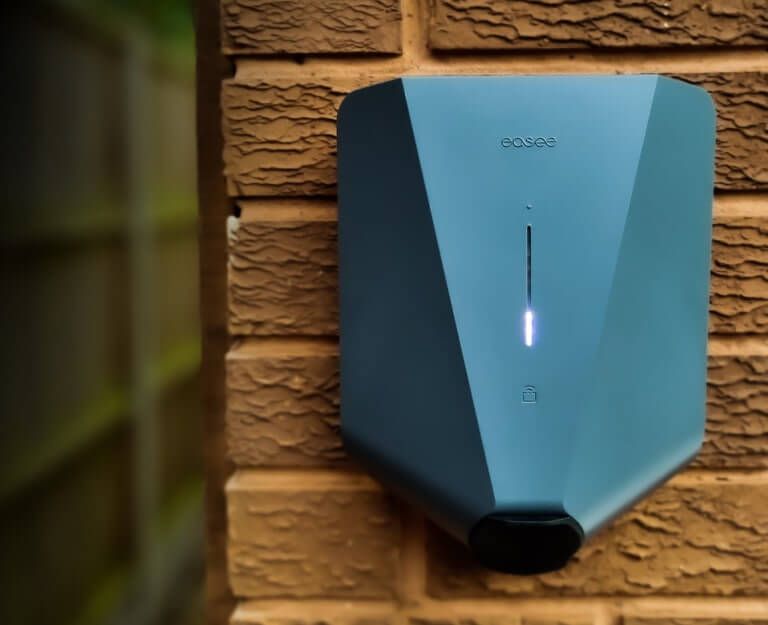
The Norwegian-engineered Easee One delivers intelligent, adaptive charging in an ultra-compact form factor, with advanced load balancing capabilities that set it apart in the UK market.
Key Specifications:
- Power Output: 1.4kW to 7.4kW (fully dynamic)
- Charging Speed: Up to 28 miles of range per hour
- Cable Type: Type 2 socket (untethered)
- Connectivity: Wi-Fi 2.4GHz, built-in eSIM (LTE Cat M1)
- Dimensions: 256mm x 193mm x 106mm
- Weight: 1.5kg
- Warranty: 3 years
- Protection Rating: IP54 (backplate IP22 without cover)
- Impact Rating: IK10
What Makes It Stand Out:
Easee’s engineering philosophy centres on universal compatibility and intelligent adaptation. The One automatically detects vehicle requirements, power supply characteristics, and grid conditions, adjusting charging parameters without user intervention. This “set it and forget it” approach appeals to users wanting charging to just work without technical complexity.
The compact dimensions – roughly 80% smaller than comparable 7.4kW chargers – create new installation possibilities. At 256mm tall and 193mm wide, the One fits locations where standard chargers simply won’t. The minimalist Scandinavian design features six interchangeable colour facias (purchased separately), allowing aesthetic customisation.
Fully dynamic charging power from 1.4kW to 7.4kW enables the One to adapt perfectly to available electrical capacity. Unlike fixed-output chargers that draw maximum power regardless of grid conditions, the One can throttle down during peak demand or ramp up when capacity is available.
Wireless load balancing represents a signature feature. Up to three Easee chargers on the same circuit can communicate via the proprietary Easee Link RF protocol, automatically distributing available power between vehicles. If one vehicle completes charging, its allocated power shifts to others still charging. This sophisticated queuing system maximises efficiency without requiring external load management hardware.
Solar charging support requires the optional Easee Equalizer accessory, which monitors PV generation and household consumption. The system can automatically adjust EV charging to consume excess solar production, though this functionality isn’t built-in like some competitors.
Integrated PEN conductor protection eliminates earth rod installation requirements, reducing both installation cost and time. Built-in ground fault detection (RCD AC 30mA / DC 6mA) provides comprehensive electrical protection meeting BS 7671:2018/A1:2020 standards.
The Easee app offers intuitive control over scheduling, monitoring, and access management. Create user accounts to control who can charge, lock the Type 2 cable permanently to the charger for security, and override pre-configured schedules with a single tap. The built-in RFID/NFC reader (compatible with ISO 14443 and MIFARE Classic) enables keyless authentication for multiple users.
The LED status ring communicates charger state through colour-coded indications. Real-time updates via the app complement this visual feedback, ensuring you’re always informed about charging progress.
Connectivity impresses with redundant options. Wi-Fi 2.4GHz provides primary internet connection, while the built-in eSIM (LTE Cat M1) offers backup cellular connectivity. This dual-path approach ensures reliable smart charging even if Wi-Fi drops. OCPP 1.6 protocol support and open API access provide flexibility for integration with third-party systems.
Operating temperature range from -30°C to +40°C exceeds most competitors, ensuring reliable performance through the harshest UK winters. The charger complies with 2014/53/EU (RED), 2011/65/EU (RoHS), 2014/30/EU (EMC), 2014/35/EU (LVD), and The Electric Vehicles (Smart Charge Points) Regulations 2021.
User experiences with the Easee One vary. Installation quality is generally good, with the compact design and integrated protections simplifying the process. However, some users report challenges with customer service responsiveness, particularly when faults occur. The company covers most repairs under warranty, though resolution times can vary.
Common issues reported include units occasionally charging below the expected 7.4kW rate, though firmware updates have addressed many of these concerns. The permanent cable locking feature divides opinion – some users appreciate the security, while others prefer the flexibility to remove and store cables.
Best For: Homeowners seeking ultra-compact design, advanced wireless load balancing, and universal vehicle compatibility with minimal setup complexity.
6. Myenergi Zappi v2.1
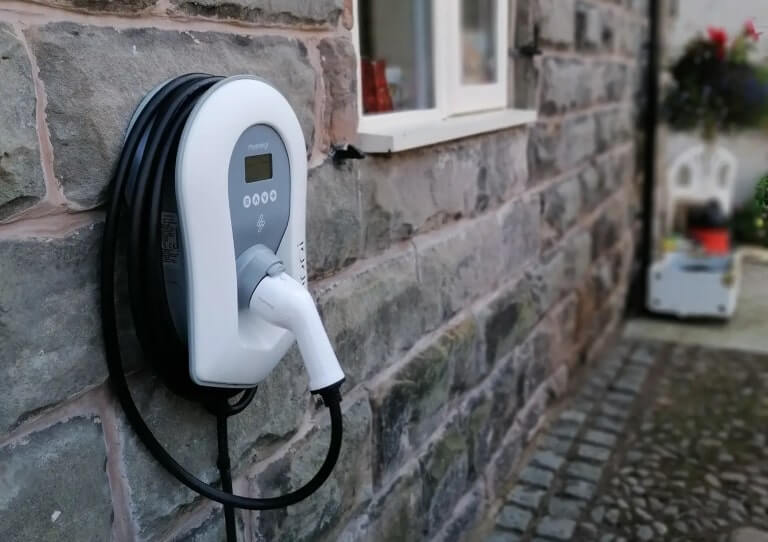
The Myenergi Zappi v2.1 pioneered solar-integrated EV charging and remains the benchmark for homeowners with renewable energy systems, offering three distinct charging modes optimised for different scenarios.
Key Specifications:
- Power Output: 7kW (single-phase) or 22kW (three-phase)
- Charging Speed: Up to 30 miles of range per hour (7kW)
- Cable Length: 6.5m (tethered models)
- Connectivity: Wi-Fi 2.4GHz, Ethernet port, wireless 868/915MHz
- Dimensions: 438mm x 282mm x 122mm
- Weight: Not specified
- Warranty: 3 years (extendable to 5 years)
- Protection Rating: IP65
- Impact Rating: IK10
What Makes It Stand Out:
Myenergi designed the Zappi specifically to maximise self-generated renewable energy usage, and this laser focus shows in every feature. The charger supports three distinct modes – FAST, ECO, and ECO+ – each optimised for different charging scenarios and energy priorities.
FAST mode operates like a conventional charger, delivering maximum power regardless of source. Use this when you need the quickest possible charge and aren’t concerned about optimising renewable energy usage.
ECO mode charges from a mixture of excess self-generated energy and grid import. The clever part: ECO ensures continuous charging by drawing a minimum 1.4kW from the grid if excess generation falls below this threshold. This prevents the frustrating stop-start charging that plagues some solar-only systems during variable sunshine.
ECO+ mode is pure renewable charging – every electron delivered to your vehicle comes from excess solar or wind generation that would otherwise export to the grid. Charging pauses if generation drops below the minimum vehicle input and resumes when sufficient surplus power returns. This mode maximises environmental benefits and minimises costs for homeowners with generous renewable installations.
The graphical backlit LCD display sets the Zappi apart from app-only competitors. Check charging status, mode selection, power flow, and session data directly on the unit without reaching for your phone. The multi-colour LED bolt logo provides additional visual status indication.
Integrated Wi-Fi eliminates the need for a separate communication hub, simplifying installation and reducing potential failure points. The Ethernet port offers wired connectivity where Wi-Fi coverage is poor. Proprietary 868/915MHz wireless enables communication with other Myenergi devices like the Eddi (solar diverter) and Libbi (home battery).
The Myenergi ecosystem integration represents a major advantage for homeowners with multiple renewable energy devices. The system can prioritise surplus generation across devices – directing excess solar to power your home first, charge your EV via Zappi second, heat water via Eddi third, or store in Libbi for later use. This holistic approach maximises renewable energy self-consumption.
Dynamic load balancing monitors household consumption and adjusts charging current to prevent circuit overload. The optional setting to limit current drawn from the grid supply or the main house supply provides granular control over electrical demand.
Current transformers (CTs) monitor both load and generation with impressive accuracy – designed to meet Class B (1%) of EN 50470 standard. Load monitoring accuracy: 0.25A-5(32)A. External CT accuracy: 0.25A-5(100)A. Up to 100A primary current supported with 16mm maximum overall cable diameter.
Installation flexibility impresses with rear or bottom supply cable entry, plus the option for indoor or outdoor mounting. Built-in 6mA DC residual current protection (RDC-DD tripping characteristics per EN 62955) provides comprehensive electrical safety without requiring expensive Type B RCD installation.
The Zappi operates across an impressive temperature range: -25°C to +40°C (out of direct sunlight). Operating humidity tolerance isn’t specified but the IP65/IK10 construction ensures reliable outdoor performance in typical UK weather.
OCPP 1.6J protocol support (via cloud) enables integration with fleet management systems or commercial charging networks. The open architecture philosophy extends to the app, which allows remote access and control from anywhere worldwide.
User feedback reveals mixed experiences with the Zappi. While the solar integration features work excellently and the hardware proves durable, some users report challenges with customer service when issues arise. Response times vary considerably, and not all problems are resolved quickly. However, when repairs are performed, most are covered under warranty at no charge.
Common issues include units requiring complete replacement due to hardware failures, plus occasional software and app glitches. The installation process generally proceeds smoothly, particularly for experienced electricians familiar with renewable energy systems. The unit ships with clip-on grid sensors, and installation complexity depends on renewable energy integration requirements.
Best For: Homeowners with solar panels or wind generation seeking maximum renewable energy self-consumption and comprehensive ecosystem integration.
Best 3-Phase EV Chargers
Three-phase chargers deliver significantly faster charging speeds than single-phase alternatives, but require a three-phase electricity supply – uncommon in residential properties but standard in many commercial settings. For compatible homes and businesses, these chargers can deliver 11kW to 22kW charging power, dramatically reducing charging times.
7. Pod Point Solo 3S (7kW version included for completeness)

The Pod Point Solo 3S combines sleek design with robust reliability, backed by one of the UK’s most established EV charging companies with over 250,000 installations since 2009.
Key Specifications:
- Power Output: 7kW (single-phase covered here; 22kW three-phase available)
- Charging Speed: Up to 28 miles of range per hour
- Cable Options: 5m tethered Type 2 or untethered socket
- Connectivity: Wi-Fi (IEEE 802.11bgn)
- Dimensions: 330mm x 290mm x 112mm (167mm for socketed)
- Weight: 3.5kg (socket), 6kg (tethered)
- Warranty: 3 years
- Protection Rating: IP54 enclosure (IP44/54 for plugs/socket)
- Impact Rating: IK10
What Makes It Stand Out:
Pod Point’s experience shows in the Solo 3S’s refined design and proven reliability. The polycarbonate enclosure achieves IK10 impact resistance while maintaining the sleek oval profile that’s become a Pod Point signature. Available in black/grey finish, the unit blends into most installation environments.
The Energy Clamp technology (single-phase only) deserves special attention. This innovative system protects your home’s main fuse from overcurrent situations that might result from adding EV charging load. By monitoring total household consumption, the Solo 3S can reduce charging power to prevent tripping the main fuse – invaluable in older properties approaching supply capacity limits.
Pod Point’s PEN isolation system eliminates earth rod installation requirements, complying with BS 7671:2018 regulation 722.411.4.1 (v) without the expense and disruption of additional earthing infrastructure. This feature significantly reduces installation costs compared to older charger designs.
Auto Power Balancing dynamically adjusts charging current based on available electrical capacity. The system monitors household load and reduces EV charging when other appliances are drawing power, then ramps back up when capacity becomes available. This intelligent load management prevents nuisance trips while maximising charging speed.
The Pod Point app provides comprehensive remote control and monitoring. Start and stop charging sessions, create schedules aligned with cheap overnight tariffs, track energy consumption, and view historical charging data. The interface is clean and logical, avoiding the feature bloat that complicates some competitor apps.
Socket locking mechanisms (socketed models) meet BS 7671:2018 regulation 722.55.101.4, providing statutory security against cable theft or unauthorised use. The tethered version includes a purpose-designed cable holster for neat storage when not charging.
Built-in 6mA DC leakage protection complies with BS 7671:2018 regulation 722.531.2.101, working safely with Type A RCD/RCBO instead of requiring more expensive Type B RCD installation. Certified installations include double or four-pole RCD protection fitted at source, covering the entire installation per regulation 722.531.2.1.1.
Standby power consumption below 2.5W keeps running costs minimal. The unit operates across -25°C to 50°C, covering all UK weather conditions with margin to spare. Charging rates adjust automatically from 0 to 32A AC RMS based on vehicle requirements and available supply capacity.
User satisfaction reveals solid overall performance from this established brand. Installation generally proceeds smoothly, though experiences can vary depending on which approved installer handles the work. The Energy Clamp and PEN isolation features work reliably in practice.
Some users report issues with app connectivity and occasional software glitches. Pod Point’s customer service experiences vary – the company covers most repairs under warranty, though response times and resolution rates differ. The unique subscription model allows customers to pay monthly fees rather than upfront purchase costs – an interesting option for those wanting to spread expenses.
The Solo 3S ships with smart features enabled by default, requiring configuration during initial setup. Over-the-air firmware updates keep the system current, and the charger complies with UK Smart Charging Regulations 2021.
UK and European-based manufacturing facilities ensure quality control, while in-house customer support teams provide locally-based assistance. The three-year warranty is standard for the category, though some competitors now offer longer coverage.
Best For: Homeowners seeking proven reliability from an established UK company with strong load balancing features and flexible payment options.
8. Andersen A3

Image via Andersen
The Andersen A3 represents the pinnacle of premium home EV charging, combining sustainable materials, customisable aesthetics, and exceptional build quality with comprehensive smart features.
Key Specifications:
- Power Output: 7.2kW (single-phase) or 22kW (three-phase)
- Charging Speed: Up to 30 miles of range per hour (7.2kW)
- Cable Type: Tethered Type 2
- Connectivity: Wi-Fi and Bluetooth
- Dimensions: Not specified (larger than Quartz)
- Weight: Not specified
- Warranty: 7 years
- Protection Rating: IP65
- Impact Rating: Not specified
What Makes It Stand Out:
The A3 occupies Andersen’s premium tier, and every aspect reflects this positioning. Sustainable materials form the core construction, with optional front panels in Cotswold Oak Accoya, ash, or various powder-coated finishes. The ability to colour-match the casing (including cream options) allows the charger to complement period properties or modern homes equally well.
The integrated cable holster represents thoughtful design. When not charging, the cable wraps neatly inside the unit, presenting a clean facade to visitors and neighbours. An interior light illuminates the holster compartment, simplifying cable retrieval in darkness – a small detail that improves daily usability.
Construction quality exceeds standard chargers. The wooden front panels and metal casing maintain appearance through harsh weather exposure. Long-term users report no degradation from rain, snow, frost, or intense summer sun. This durability justifies the premium pricing for homeowners viewing the charger as a long-term installation.
The concierge service differentiates Andersen from competitors. Every customer receives a named contact who handles queries, troubleshoots issues, and coordinates any required service. This personalised approach has earned Andersen strong customer service satisfaction among UK buyers.
Smart charging capabilities mirror the Quartz but with additional refinement. The app enables complex scheduling scenarios – for instance, programming different charge targets for weekdays versus weekends, or setting vehicle preconditioning timing for cold mornings. Integration with home energy management systems allows the A3 to participate in broader household power optimisation.
The A3 excels at scheduled charging, a crucial feature for exploiting cheap overnight rates. Unlike some chargers where vehicles “go to sleep” and fail to respond when scheduled charging starts, the A3’s programming options allow synchronisation between charger and vehicle wake-up timing.
Variable current capability (6A to 32A with CT-monitored adaptive fuse) provides sophisticated load management. The system continuously monitors household consumption and adjusts charging power to maintain safe operation within your supply capacity.
Installation by Andersen’s in-house team ensures consistent quality. The surveyor visit assesses electrical infrastructure and discusses optimal placement. Fitters are described as friendly, helpful, and willing to answer questions – a welcome change from contractors who rush through installations.
Real-time health monitoring, start-up self-tests, earth monitoring, welded contactor monitoring, and PME monitoring provide comprehensive safety oversight. These multiple layers of protection exceed regulatory requirements and demonstrate Andersen’s commitment to safe operation.
Andersen’s approach to customer service consistently earns praise. The company responds promptly to issues and covers repairs under the generous seven-year warranty. The extended warranty period provides exceptional peace of mind and reflects confidence in product longevity.
The seven-year warranty, introduced across Andersen’s range in 2024, provides exceptional peace of mind. This extended coverage reflects confidence in product longevity and offers superior value over the product lifecycle compared to three-year warranties.
Pricing sits at the premium end. The charger costs £995, premium wood fronts add £200, and fitting typically costs £395 – though recent fixed-price standard fitting has improved cost predictability. Total investment around £1,590 represents significant outlay, but the quality, service, and warranty coverage justify the premium for many buyers.
Best For: Homeowners prioritising aesthetics, sustainable materials, premium build quality, and white-glove service, particularly for period or architecturally significant properties.
Understanding EV Charger Features
Choosing the best home EV charger requires understanding several technical specifications and features. This section breaks down the key terms and concepts to help you make an informed decision.
What Does kW (Kilowatt) Mean for EV Charging?
Kilowatts (kW) measure the charging power – essentially how fast electricity flows into your vehicle’s battery. Higher kW ratings mean faster charging.
Common power levels:
- 3.6kW: Basic charging, adds roughly 12-15 miles of range per hour
- 7kW-7.4kW: Standard home charging, adds 25-30 miles of range per hour
- 11kW: Fast home charging (requires three-phase supply), adds 35-40 miles of range per hour
- 22kW: Rapid home charging (requires three-phase supply), adds 60-70 miles of range per hour
Most UK homes have single-phase electricity supply, limiting charging to 7-7.4kW maximum. Three-phase supply, common in commercial properties but rare in homes, enables 11kW or 22kW charging.
To put this in perspective: a 7kW charger can fully charge a typical 50kWh EV battery from empty in about 7-8 hours – perfect for overnight charging. A 22kW charger reduces this to 2-3 hours, though your vehicle must support this charging rate.
Understanding Single-Phase vs Three-Phase Power
Your home’s electrical supply type determines maximum charging speed. Most UK residential properties have single-phase supply, which provides power through one live wire and one neutral wire.
Three-phase supply uses three live wires carrying alternating currents offset from each other, providing more consistent power delivery and higher total capacity. Upgrading from single-phase to three-phase typically costs £3,500-£5,000+ due to required infrastructure changes: new underground cables, upgraded fuse box, distribution panel, and meter.
Before considering a three-phase charger, check your property’s current supply. Look at your fuse box: single-phase systems typically have one large fuse controlling the main circuit; three-phase systems have three equally sized large fuses, often rated 100 amps each.
What Is Dynamic Load Balancing?
Dynamic load balancing (also called Auto Power Balancing or load management) prevents circuit overload by monitoring total household electrical consumption and adjusting EV charging power accordingly.
Here’s how it works: When you’re cooking dinner with the electric oven, boiling kettle, and running the dishwasher, the load balancing system detects this high consumption and reduces EV charging power. Once those appliances finish, charging power ramps back up automatically.
This intelligent management prevents nuisance trips of your main circuit breaker while allowing EV charging to coexist with normal household activities. For homes approaching their maximum supply capacity, dynamic load balancing is essential.
Some advanced systems can balance load across multiple EV chargers, distributing available power between vehicles. The Easee One, for example, can wirelessly coordinate up to three chargers on the same circuit.
Solar Integration and ECO Charging Modes
Solar integration allows your EV charger to prioritise charging from excess solar panel generation, maximising renewable energy usage and minimising grid electricity consumption.
ECO and ECO+ modes (terminology varies by manufacturer):
ECO mode charges from a mixture of solar generation and grid import. If solar production drops below minimum vehicle charging requirements (typically 1.4kW), the charger draws supplementary power from the grid to maintain continuous charging.
ECO+ mode charges exclusively from excess solar generation that would otherwise export to the grid. Charging pauses if solar output falls below the minimum threshold and resumes when sufficient excess power returns.
FAST mode charges at maximum rate regardless of power source – useful when you need the quickest possible charge and aren’t prioritising solar usage.
Solar integration requires either built-in monitoring (as in the Myenergi Zappi) or compatible accessories like current transformers (CTs) that measure solar production and household consumption. Not all chargers support solar integration, so check specifications if this feature is important.
What Are Smart Charging Regulations?
Since June 2022, all new home EV chargers installed in the UK must comply with The Electric Vehicles (Smart Charge Points) Regulations 2021. These regulations mandate several features:
Internet connectivity: Chargers must connect to an electronic network for remote monitoring and control.
Default off-peak charging hours: Pre-programmed to charge during low-demand periods (typically 11pm-8am), though users can override these settings.
Random delay function: To prevent grid stress from thousands of chargers starting simultaneously at cheap rate changeover times.
Security requirements: Data encryption and protection against unauthorised access.
Energy consumption monitoring: Tracking and reporting electricity usage for transparency.
Smart chargers enable you to schedule charging during cheapest electricity periods, monitor costs via apps, and allow electricity suppliers to participate in demand response programs that help balance grid load.
Understanding IP and IK Ratings
IP (Ingress Protection) ratings indicate how well the charger resists dust and water:
- IP54: Protected against dust and water splashes from any direction (this is also an ideal rating for charging cables)
- IP55: Protected against dust and low-pressure water jets from any direction
- IP65: Dust-tight and protected against water jets from any direction (recommended for outdoor installation)
- IP66: Dust-tight and protected against powerful water jets (excellent outdoor protection)
IK (Impact Protection) ratings measure resistance to mechanical impacts:
- IK08: Withstands 5 joules of impact (equivalent to 1.7kg dropped from 30cm)
- IK10: Withstands 20 joules of impact (equivalent to 5kg dropped from 40cm) – vandal-resistant
For outdoor installations, look for minimum IP54 and ideally IK10 ratings to ensure the charger survives UK weather and accidental impacts.
What Is PEN Fault Protection?
PEN (Protective Earth and Neutral) fault protection is a critical safety feature now required in the UK. In TN-C-S electrical systems (standard in most UK homes), the protective earth and neutral share a common conductor.
If this combined conductor breaks (a PEN fault), dangerous voltages can appear on exposed metalwork, including your EV’s chassis. PEN fault protection detects this condition and immediately stops charging.
Modern chargers include built-in PEN fault detection, eliminating the need to install expensive earth rods (which could cost £500-£1,000+ in difficult ground conditions). Look for compliance with BS 7671:2018 regulation 722.411.4.1 when evaluating chargers.
What Are RCD and DC Leakage Protection?
RCD (Residual Current Device) protection detects current imbalances between live and neutral conductors, indicating electricity is leaking to earth – potentially through a person. Type A RCDs protect against AC current leakage.
DC leakage protection is specifically required for EV charging because vehicle power electronics can produce DC earth leakage currents that Type A RCDs cannot detect. Most modern chargers include built-in 6mA DC leakage detection (per EN 62955 or IEC 62955), allowing safe operation with standard Type A RCDs rather than expensive Type B RCDs.
This integrated protection significantly reduces installation costs. Older chargers lacking DC leakage protection require Type B RCD installation, which can add £200-£400 to installation costs.
Tethered vs Untethered Chargers
Tethered chargers have a charging cable permanently attached, ready to plug into your vehicle. Advantages include convenience (no cable retrieval from your car) and integrated cable management. Disadvantages include aesthetic impact (cable visible even when not charging) and inflexibility if you change to a vehicle with different connector requirements.
Untethered (socketed) chargers have a Type 2 socket accepting your vehicle’s charging cable. Advantages include neater appearance when not in use and flexibility to use different cables. Disadvantages include the need to retrieve your vehicle’s cable for each charging session.
Cable lengths for tethered models typically range from 5.0m to 7.0m. Longer cables provide installation flexibility but may look untidy. Consider the distance between your charger mounting location and vehicle charging port when selecting cable length.
What Is RFID and Access Control?
RFID (Radio-Frequency Identification) allows access control using key cards or fobs. Wave the authorised card near the charger to unlock and enable charging. This prevents unauthorised use and allows multiple authorised users (family members, visitors) with tracked individual usage.
Some chargers include NFC (Near Field Communication) functionality, compatible with smartphones and certain contactless cards. This provides alternative access methods beyond dedicated RFID cards.
For workplace or shared chargers, RFID is essential. For home use, it’s optional but useful if you want to restrict access or track usage by different drivers.
Understanding Warranty Coverage
Warranty periods vary significantly across manufacturers:
- 3 years: Industry standard (Hypervolt, Easee, Ohme, Pod Point, Wallbox, Myenergi)
- 5 years: Premium offering (sometimes available as paid extension)
- 7 years: Industry-leading (Andersen)
Check what the warranty covers: parts only, or parts and labour? Who performs warranty repairs: the manufacturer’s in-house team, or third-party contractors? How quickly do they respond to warranty claims?
Extended warranties sometimes cost extra. Evaluate whether the peace of mind justifies the additional expense based on the charger’s reliability record and manufacturer’s service reputation.
Final Recommendations
The best home EV charger for you depends on your specific needs, budget, and circumstances:
For maximum reliability and premium support: Hypervolt Home 3 Pro or Andersen A3 lead in fault resolution and customer service.
For compact installation and tariff integration: Ohme ePod delivers exceptional value in a minimal footprint.
For solar panel owners: Myenergi Zappi v2.1 remains the benchmark for renewable energy integration. Also check out our solar panel EV charging calculator.
For three-phase installations: Consider the 22kW versions of Pod Point Solo 3S or Myenergi Zappi for rapid charging.
For premium aesthetics: Andersen A3 with customisable sustainable materials suits period or architecturally significant properties.
For budget-conscious buyers: Andersen Quartz provides premium features and industry-leading warranty at accessible pricing.
Remember to factor in total cost of ownership: purchase price plus installation costs, potential savings from tariff integration, warranty coverage, and likely service requirements over the product’s lifetime.
The home EV charging market has matured significantly, offering proven solutions for every use case. Whether you prioritise speed, solar integration, compact design, or white-glove service, excellent options exist across all price points.
