




EO Charging, once a prominent name in the UK’s electric vehicle infrastructure sector, has entered administration after years of financial difficulty, failed expansion efforts and a last-ditch acquisition process that came to nothing.
The Suffolk-based company, which traded under the name Juuce Limited, had PwC appointed as joint administrators on 8 April 2026. Of its 93 employees, 69 were made redundant immediately, with the remaining 24 kept on temporarily to help wind down operations and transition existing customers to alternative suppliers.
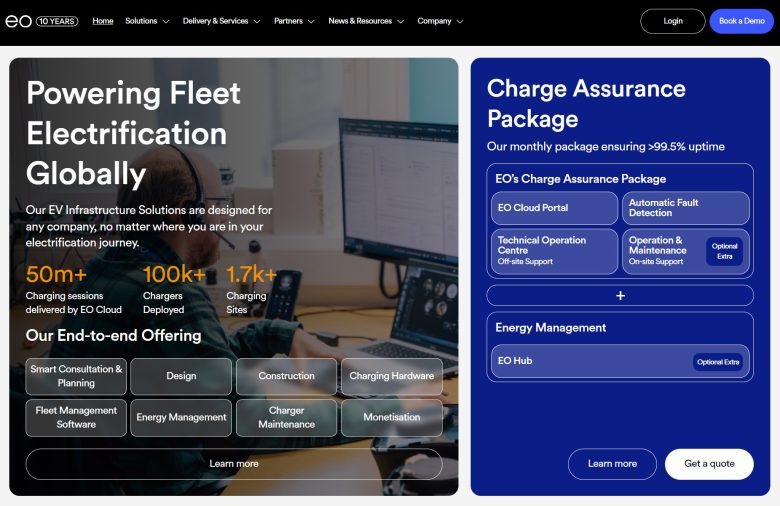
EO Charging had built a strong reputation in fleet and commercial charging. The company supplied charging hardware, cloud-based management software and round-the-clock maintenance services to supermarkets and large UK fleet operators.
Over the course of its life, it manufactured more than 85,000 chargers and deployed around 13,000 commercial charging stations across 35 countries.
Where it went wrong
The trouble began with an ambitious overseas expansion into the United States, Australia, New Zealand and Italy. The international push stretched the company’s resources and failed to deliver the returns needed to sustain it. By the second half of 2025, EO had pulled back from all four markets to refocus entirely on the UK and its cloud-based charge point management platform.
In November 2025, alongside a £25 million recapitalisation effort, the company sold its domestic EV charger hardware and manufacturing arm to electronic manufacturer Cogent Technologies. The aim was to pivot towards a leaner, platform-led business model. A successful fundraising round also took place that autumn, bringing in fresh capital from shareholders.
But it wasn’t enough. Liquidity problems resurfaced, and in January 2026 the company launched an accelerated mergers and acquisitions process in the hope of finding a buyer or partner. That process failed to produce a deal, leaving the company with no viable path forward other than administration.
PwC confirmed that despite the additional shareholder support and the late-2025 fundraise, EO Charging remained loss-making throughout. The administrators are now focused on selling off the company’s remaining assets to recover value for creditors.
A sector under pressure
EO’s collapse does not exist in isolation. The UK’s EV charging sector has been going through a period of rapid consolidation, with rising costs, intense competition and ongoing funding pressures forcing smaller and mid-sized operators to either exit the market or find buyers. It’s why The UK Gov recently slashed installation costs.
In recent months, Be.EV agreed to acquire Statkraft-owned Mer’s UK public charging network. Connected Kerb purchased Trojan Energy out of administration. Shell-owned Ubitricity took over FM Conway’s SureCharge network. The pattern is clear: larger, better-capitalised players are absorbing the infrastructure that smaller companies can no longer afford to maintain and grow.
Industry figures have pointed to a fundamental tension in the market. Building out EV charging infrastructure requires enormous upfront capital, but returns are slow to materialise, particularly when utilisation rates at many charge points remain low. Companies that expanded too quickly or burned through cash chasing scale have found themselves exposed.
Demand is growing, though
The irony is that EO’s administration comes at a time when EV demand in Europe is accelerating. Global EV sales reached four million in the first quarter of 2026, and while that figure was down three per cent year on year overall, Europe bucked the trend.
First quarter sales across the continent rose 27 per cent, with March volumes hitting a record monthly high of almost 540,000 vehicles. Analysts have attributed the rebound to a combination of government subsidies, tightening emissions regulations and higher petrol prices linked to ongoing disruption in the Middle East.
The UK itself saw record EV registrations in March 2026, with 86,000 battery electric vehicles sold in a single month.
The demand is there. The challenge, as EO Charging’s story shows, is surviving long enough to benefit from it.
